
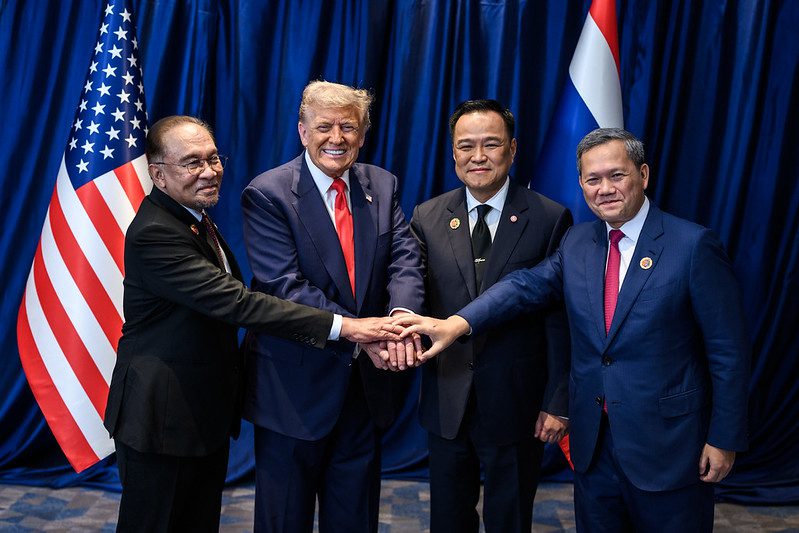
Thai fighter jets struck multiple targets deep inside Cambodian territory on Monday in a dramatic escalation of border hostilities, effectively shattering the fragile ceasefire agreement brokered barely two months ago by US President Trump.
The precision airstrikes, which the Royal Thai Air Force (RTAF) described as a necessary preemptive move to “cripple” Cambodia’s offensive capabilities, mark the fiercest direct combat between the historic rivals since the bloody temple standoffs of 2011 and the flash-conflicts of July 2025. The renewed violence has already resulted in confirmed fatalities, the mobilisation of heavy armor, and the chaotic displacement of nearly half a million civilians, raising fears that a localised border skirmish is spiraling into a full-scale regional war.
The Spark: A Weekend of Violence
While tensions have simmered for weeks, the situation deteriorated rapidly over the weekend. The catalyst appears to have been a chaotic firefight late Sunday night in the dense jungles of the Dangrek Mountains.
Thai authorities reported that a patrol unit near the disputed Preah Vihear temple complex was ambushed by heavy mortar fire and drone-dropped munitions, killing one Thai ranger instantly and critically injuring others. Bangkok claims this was the final straw following a month of “provocations,” including the maiming of a Thai soldier by a freshly laid landmine in November; an incident that had already led Thailand to suspend de-escalation protocols.
By Monday morning, the conflict had transformed from border skirmishes to air superiority operations.
“Cripple Their Capability”: The Thai Offensive
In a televised address that stunned regional observers, the Thai military command confirmed the deployment of F-16 Fighting Falcons to strike logistics hubs and artillery batteries inside Cambodia.
“We are no longer firing warning shots,” stated General Chaipruak Doungprapat, the Thai army chief of staff, in a briefing from the 2nd Army Area Command. “The objective of the army is to cripple Cambodia’s military capability for a long time to come. We are acting for the safety of our children and grandchildren, ensuring that the threat from across the border is neutralised.”
Bangkok asserts the airstrikes were defensive, targeting drone launch sites and ammunition depots that Thai intelligence claims were being prepared for a cross-border offensive. The Thai Army also released grainy aerial footage purported to show Cambodian BM-21 truck-mounted rocket systems moving into firing positions aimed at Thai civilian population centres in Sisaket province.
Cambodia: “Inhumane Aggression”
In Phnom Penh, the mood is one of shock and defiance. The Cambodian government has vehemently denied instigating the Sunday clash, portraying the airstrikes as a disproportionate and “inhumane” act of bullying by a wealthier, better-armed neighbour.
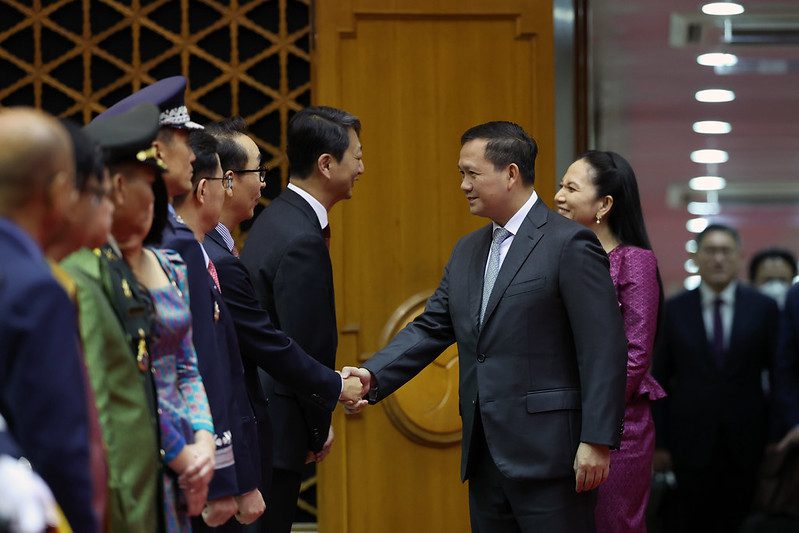
Image: Cambodian Prime Minister Hun Manet and his wife Pich Chanmony in South Korea – Republic of Korea / Jeon Han
“Thailand is fabricating pretexts for an invasion,” read a furious statement from the Cambodian Defence Ministry. “Our forces have maintained strict discipline. We came under sustained bombardment from air and ground but exercised maximum restraint.”
However, that restraint may be fraying. Hun Sen, the country’s influential former leader and father of current Prime Minister Hun Manet, took to Facebook to rally national sentiment. While he publicly urged patience, his language hinted at a looming counter-strike.
“All frontline forces must remain patient because the aggressors have been firing all kinds of weapons,” Hun Sen wrote. “But they are trying to bait us. We must be smart, but we must be ready. They have crossed a line.”
Observers note that while Cambodia lacks Thailand’s air power, its artillery capabilities and seasoned ground forces make a prolonged ground war a deadly prospect for both sides.
“There Will Be No Talks”: Diplomacy Deadlocked
Diplomatic avenues appear to have completely collapsed. Thai Prime Minister Anutin Charnvirakul, known for his populist rhetoric, adopted an uncompromising hardline stance on Monday, rejecting calls for an immediate summit.
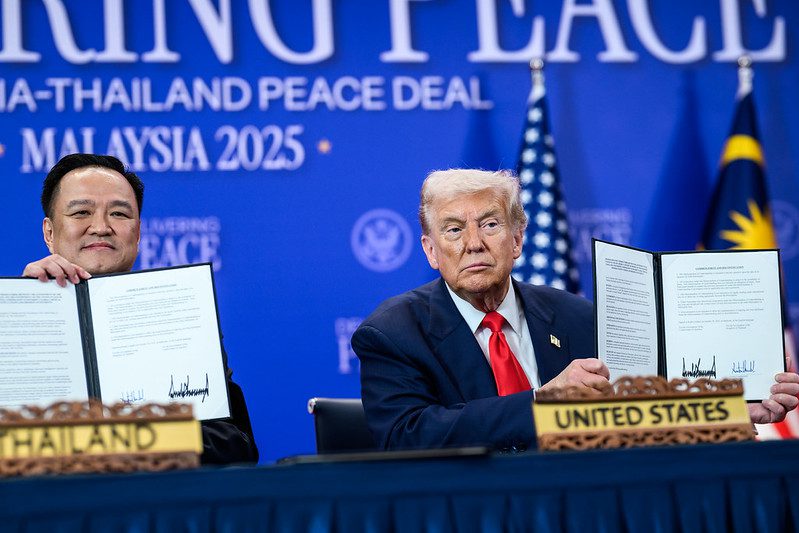
Image: Prime Minister Anutin Charnvirakul signs the Kuala Lumpur Accord alongside President Trump – The White House / Daniel Torok
“There will be no talks. If the fighting is to end, they must do what Thailand has set,” Anutin told reporters outside Government House, emphasising that his administration would prioritise territorial integrity over diplomacy. “We gave peace a chance. They used it to reload.”
This refusal effectively nullifies the “Trump Accord,” a diplomatic victory touted by the US President earlier this year. The collapse of the deal is a significant blow to US prestige in the region, leaving a vacuum that regional powers are struggling to fill.
Humanitarian Emergency
Official tolls confirm one Thai soldier and four Cambodian civilians killed in the initial salvos. However, unverified reports from border villages suggest higher civilian casualties on the Cambodian side due to the airstrikes.
Hospitals in Thailand’s Ubon Ratchathani province are treating 18 wounded soldiers, while Cambodian medical units report at least nine civilian injuries, including children.
Thailand has evacuated approximately 438,000 civilians across five border provinces, turning schools and temples into makeshift shelters.
Regional Shockwaves
The escalation has drawn immediate concern from the Association of Southeast Asian Nations (ASEAN). Malaysian Prime Minister Anwar Ibrahim, who served as a key co-broker of the original ceasefire, issued an urgent plea for de-escalation.
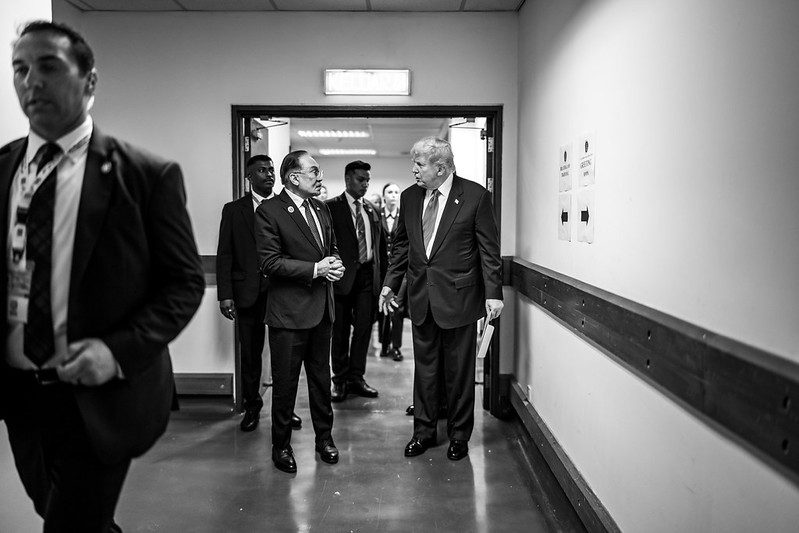
IMAGE: President Donald Trump speaks with Malaysian Prime Minister Seri Anwar Ibrahim – The White House / Daniel Torok
“The renewed fighting risks unraveling the careful work that has gone into stabilising relations,” Anwar wrote on X (formerly Twitter), warning that a prolonged conflict could destabilise the entire Mekong sub-region.
As night falls over the border, artillery duels continue to be reported near the Preah Vihear temple. With the US administration yet to issue a formal response to the collapse of its deal, and Bangkok refusing to answer the phone, the window to prevent a full-scale war is closing fast. The breakout of the conflict marks a major to President’s campaign to establish peace across the world, and could raise questions about his deals in Gaza and Ukraine, as to whether they are short-term answers incapable of solving longer-term issues.
Featured Image via The White House – Daniel Torok