

Solar for Schools hosted a parliamentary event at the Attlee Suite, Portcullis House, bringing together MPs, education leaders, energy companies, community energy groups, and students to examine how solar installations in schools can reduce energy costs, support decarbonisation, and inform future government policy.
The event focused on the practical delivery of solar projects in schools, with particular attention on landlord consent, funding models, community energy partnerships, and the role of central government in accelerating the rollout of solar panels for schools. Speakers included Sam Rushworth MP, Minister of State for Energy, Michael Shanks, representatives from National Grid Electricity Distribution, Solar for Schools leadership, and community energy organisations, alongside pupils from participating schools.
Event Aims & Opening Remarks
Opening the event, Richard Turner, Chair of Solar for Schools, thanked sponsors, partners, and students who had travelled from across England to attend. He highlighted the diversity of stakeholders present, including policymakers, councils, multi-academy trusts, community energy groups, and students. Turner outlined the central challenge facing school solar projects: building ownership.
Richard Turner, Chair, Solar for Schools
Richard Turner opened the event by outlining the core delivery challenge facing school solar projects: landlord approval. He said that even when schools are fully prepared and funding is secured, projects can be halted if building owners refuse consent.
“A school can be really enthusiastic. We can have the funding all prepared, the school can be ready for installation, but if the landlord says no, the project stops right there.”
Turner said the purpose of the event was to make approval easier by developing clearer standards and processes for landlords and building owners. He said Solar for Schools was focused on systems thinking to support decarbonisation across school buildings, rather than treating projects on a case-by-case basis.
Sam Rushworth MP, Member of Parliament for Bishop Auckland
Sam Rushworth MP opened the parliamentary proceedings and spoke about the impact of Solar for Schools in his constituency.
He listed schools in Bishop Auckland that have already installed solar panels through the programme, including Hartside Academy, Montalbo Nursery and Primary School, Staindrop Academy, and Toft Hill Millennium Primary School.
Rushworth said the programme had an impact beyond energy generation by engaging students directly with policy and decision-making.
“It’s not just about the solar. What they do so spectacularly is engage with young people and help them to engage with policymakers.”

He said five additional schools in his constituency were due to receive solar panels through a government scheme, more than doubling local provision. He cited King James Academy, where solar panels installed in March 2025 are expected to generate savings of £671,000.
Rushworth also raised concerns about schools incurring energy costs even during holidays and said solar installations could help address this inefficiency. He concluded by emphasising student accountability.
“They may not be old enough to vote, but they’re old enough to hold us to account.”
Christopher Hayton, Director of Corporate Affairs, National Grid Electricity Distribution
Christopher Hayton outlined National Grid’s partnership with Solar for Schools and its financial commitment to supporting solar installations in schools.
He said National Grid had committed just under £3 million in grant funding to help schools in economically deprived areas install solar panels. Thirteen schools have installed systems so far under the partnership.
Hayton said these projects are projected to save more than £2.3 million in energy costs over 25 years and reduce carbon emissions by approximately 132 tonnes per year.
He said the programme also delivered educational benefits, with thousands of students participating in workshops and assemblies focused on sustainability and energy systems.
“If we’re going to do what we need to do, then we need hundreds of thousands more people,” he said, referring to future workforce needs in the energy sector.
Michael Shanks MP, Minister of State, Department for Energy Security and Net Zero
Michael Shanks MP spoke about the role of school solar within the government’s clean power and energy security agenda.
He said tackling climate change could not be delayed and described rooftop solar as a key tool in reducing reliance on fossil fuels.
“We have to tackle it now.”
Shanks said solar installations could help reduce school energy bills, allowing more funding to be directed towards education rather than utilities.
“We want more money to go right into the things that are really important to your learning.”
He also highlighted the importance of domestic energy generation, arguing that solar and wind reduced dependence on global energy markets and improved supply security.
Shanks encouraged students to challenge politicians directly and said MPs should leave the event with clear actions to take forward.
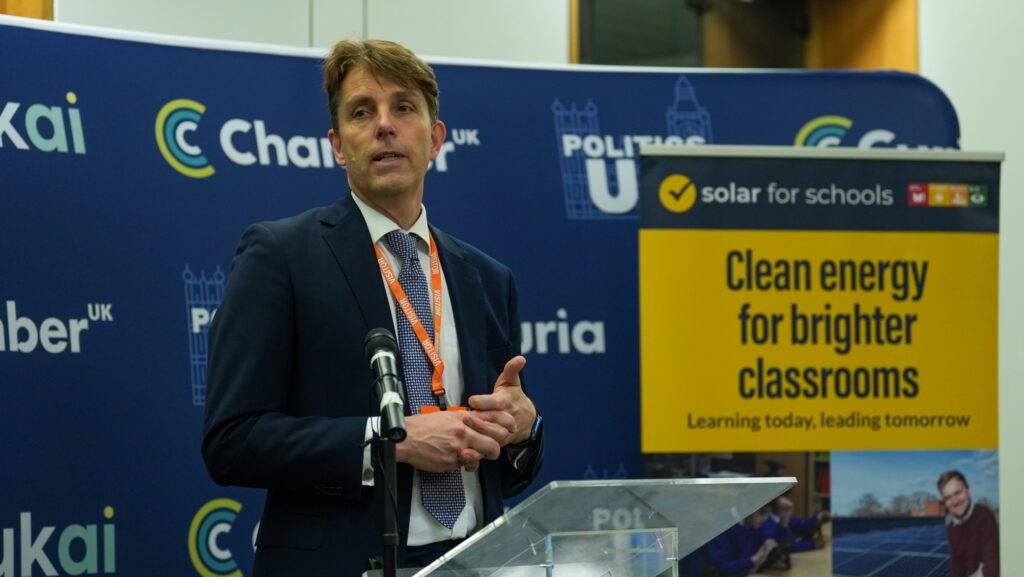
Robert Schrimpff, Co-Founder and Chief Executive Officer, Solar for Schools
Robert Schrimpff reflected on progress since the organisation’s first parliamentary event and addressed recent policy developments.
He welcomed the announcement that Great British Energy would fund solar installations in 200 to 250 schools through the Department for Education, but said delivery challenges remained.
Schrimpff said while the partnership made sense in theory, implementation had been slowed by procurement complexity and the fact that the Department for Education does not own most school buildings.
“In theory, there’s no difference, but in practice there is.”
He also said that fully funded schemes had unintentionally stalled community-led projects by encouraging schools to wait rather than proceed with existing plans.
Schrimpff argued for funding approaches that “crowd in” investment by working with community energy groups and councils, rather than crowding out local initiatives.
Barry James, Founding Team Member of Sheffield Energy Hub
Barry described how collaboration between Solar for Schools, Sheffield City Council, and local partners had accelerated solar deployment in the city.
He said the creation of the Sheffield Energy Hub had helped connect organisations that previously worked in isolation.
“The problem now isn’t that we don’t have the technology. We absolutely have the technology.”
Barry said the main challenge was coordination between stakeholders and navigating processes rather than access to funding or equipment.
Other speakers lending their support included:
- Fleur Anderson MP, Member of Parliament for Putney, spoke about the importance of reducing energy costs for public buildings and supporting local solutions to decarbonisation. She welcomed initiatives that combine infrastructure investment with education, noting that schools can act as hubs for community engagement on climate action.
- Helen Hayes MP, Chair of the Education Select Committee, highlighted the connection between energy efficiency in schools and broader education policy. She described Solar for Schools as an example of how investment in school infrastructure can deliver financial savings while also supporting learning and skills development, particularly in relation to sustainability and future green jobs.
- Daisy Cooper MP, Liberal Democrat Treasury Spokesperson, emphasised the need for long-term funding mechanisms to support the transition to clean energy. She referenced the role of low-cost finance in enabling public-sector decarbonisation and said school solar projects demonstrated how targeted investment could deliver both environmental and economic benefits.
- Emily Darlington MP, Member of Parliament for Milton Keynes Central, spoke about her experience visiting schools with solar installations in her constituency. She said schools that had installed solar panels had seen tangible savings on energy bills and increased student awareness of climate and energy issues.
- Sir Roger Gale MP, Member of Parliament for North Thanet, commented on the importance of practical delivery and value for money in public spending. He noted that programmes such as Solar for Schools showed how locally delivered projects could contribute to national clean energy objectives when barriers around approval and implementation are addressed.
Policy implications and next steps
Schrimpff identified legal agreements, particularly long-term leases and power purchase agreements, as a continuing barrier to scaling solar in schools. He said Solar for Schools was working with the Department for Education to develop standardised contracts that could be approved centrally and adopted nationally.
He said addressing legal barriers and designing funding schemes that support community energy would be critical to ensuring future programmes succeed in practice.
Final Thought
The Solar for Schools parliamentary event highlighted the gap between policy ambition and delivery on the ground. Speakers consistently identified landlord consent, legal complexity, and coordination between government departments as key obstacles to scaling solar in schools.
The event also demonstrated how school-based solar projects align with government clean power objectives while delivering financial savings and educational benefits. Discussions pointed towards a policy direction that favours collaboration with councils and community energy groups rather than fully centralised delivery.