
Lin Junyuang caused quite a stir in January. At a major AI conference in Beijing, the technical lead of Alibaba’s Qwen models said Chinese artificial intelligence companies had “a less than 20% chance” of catching up with their US counterparts in the next three to five years. Even doubling down, he said that even this was “a highly optimistic estimate.”
That came as a surprise to anyone who had been following the recent AI news emerging from China. Just weeks earlier, a Stanford University report had found that Chinese AI models had “caught up or even pulled ahead” of their American competition. In his New Year’s Address, Xi Jinping boasted about what he called a “transformative 2025 for China’s AI,” describing “breakthrough developments” on the subject. So, who is ahead of who here?
“I know it doesn’t fit into headlines, but this is so much more nuanced than just a simple ‘who’s ahead’,” says Thomas Derksen, a Shanghai-based entrepreneur, influencer and consultant who has covered the Chinese tech world for years. “It really depends on what your metrics are whether you’re looking at open or closed source, for instance.”
Open vs Closed AI Models: Where the US and China Lead
Closed-source AI models are engineered to perform a wide variety of tasks for their users, but their algorithms remain closed off and cannot be altered. “With these models, the Americans are for sure still leading the way with OpenAI, Anthropic and Google,” says Grace Shao, founder and analyst of industry newsletter AI Proem on Substack.

Image: Open AI Logo – Flickr via Trong Khiem Nguyen
“There are specific use cases where the Chinese AIs make some waves, such as in having very advanced video generation abilities,” Shao says, “but the pioneering of these general-purpose models is still being done by the American labs.”
Open-source AI models, however, are a much different story. With their code usually available publicly, developers can alter the workings of the models for their own use cases, particularly relevant when companies want to use the models. “In the end, nobody cares if you or I use the American closed source models to write a poem or get a cooking recipe,” Thomas Derksen says. “What matters is what open-source businesses are making money with- and this is where the Chinese are dominating.”
Why Businesses Are Choosing Chinese AI Models
Chinese AI models have indeed increasingly been favoured in the business world, for instance by global players like Pinterest and Airbnb, who are now using Deepseek open-source models and Alibaba’s Qwen AI respectively. Airbnb CEO Brian Chesky told the BBC the Chinese-made models were simply “good, fast, and cheap.”
“Are these Chinese models the absolute frontier technology? Probably not yet,” Grace Shao says. “But if a company from a pure business perspective wants a top-notch model in terms of performance but is also cost-conscious, they may well choose a Chinese model.”
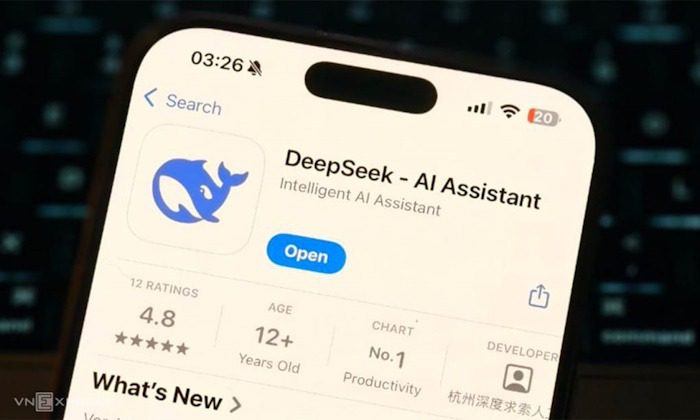
Image: Chinese AI Deepseek – Flickr via Trong Khiem Nguyen
“A lot of companies do just favour Chinese models because they’re so cheap,” Derksen agrees. “Deepseek’s models are roughly on the level of Chat-GPT 5 now,” he says, “but at a fraction of the cost. Especially in markets like Africa or Southeast Asia, many firms just can’t afford the pricey American models, and opt for the Chinese ones.”
For Derksen, this is a classic Chinese strategy. “Often when Chinese companies see that they might not quite be able to keep up in terms of quality, they bring the cost down,” he says. “And with the conditions on the ground in China, this is easy.”
Powering cheap AI, one windmill at a time
On a cold February morning in the dimly lit train station of Ulanqab, an industrial city in Inner Mongolia province in China’s far north, migrant worker Li vents his frustrations. “They have us building windmills all day out on that bloody steppe,” he grunts. “Sometimes the wind blows so cold I could freeze into an ice block.” Smirking, he points to the AI translation app flickering across his phonescreen. “The big bosses there need our windmills, though.”
To build their cheap AI models, companies like Deepseek rely on a crucial factor- China’s affordable, seemingly infinite electricity production. “Over the last decade, we have seen a huge rise in Chinese renewable energy solutions,” says Grace Shao. Once largely dependent on coal, the value of China’s green energy sector has doubled between 2022 and 2025, with massive investment into wind and solar power, often in the country’s north. China now has some of the cheapest electricity on the planet.

Image: Power lines in rural Inner Mongolia, China – Julius Buhl
And this cheap, scalable electricity allows Chinese AI-makers to run massive, energy-intensive AI training centers at a lower cost than many Western competitors. Inner Mongolia has become one of the main hubs for this, as the cold steppes are now crowded with windmills that power several state-of-the-art data centers. “The Chinese now have the capacity here, and can thus push the price down,” Shao says.
Meanwhile, the competition in America is struggling in this area. “The US grid is old, and the electricity demand has not changed in decades,” Shao says. “Expanding it now to power the AI datacenters is expensive, and there is only slow progress on unlocking new renewable power sources. This is a kind of bottleneck for the US.” And electricity is not the only area in which China seems to have a leg up these days.
China’s AI Talent Boom and the “Reverse Brain Drain”
For long, observers argued that China was struggling to pioneer new technologies because much of its prime talent headed for Silicon Valley when given the chance. “But that’s the past,” Grace Shao says.
AI-trailblazer Tencent recently hired Vinces Yao, a top researcher who worked on OpenAI’s first AI agents. Several other high-profile engineers who had previously worked in the development of key AI models in the US have recently moved across the Pacific, a trend some have dubbed a “reverse brain drain.”
“Talent is no longer a bottleneck for Chinese AI,” Grace Shao says. “Some people are homegrown, some are engineers returning from the Bay Area- either way, the calibre is very high.”
According to Derksen, this is very much part of Beijing’s plan. “If Xi Jinping declares something a priority as he has done with attracting AI talent, that impacts everyone in China; every university, every province, every city will do their best to fulfil the order,” he says. “The scientists are feeling this, they get resources and support everywhere they go in China, so it’s no surprise that a lot are heading there.”
And then, the cost factor strikes again. “I can essentially get two engineers for the price of one in China,” Thomas Derksen says. “Living costs and salaries are just much lower than in the US. There is an abundance of talent, and the Chinese working culture is still ruthless. They can just get more done in a shorter time.”
As businesses seem to favour Chinese AI powered by cheap electricity and abundant talent, it may seem like Beijing is winning this race easily. But there is one constraint China just can’t seem to shake off.
AI Chips: China’s Biggest Weakness
AI developers rely on specially designed computer microchips to train their AI models. They are incredibly hard to manufacture, and having an outdated chip can cost developers significantly more and delay model development for years. “American NVIDIA and Taiwanese TSMC are still the undisputed number one when it comes to making these chips,” Thomas Derksen says, “and they’re not letting the Chinese access them freely. And that is their biggest problem.”
Over the past few years, Washington has tightened export restrictions on advanced chips and chipmaking equipment, limiting China’s access to the crucial hardware. In December, Deepseek was accused of illegally training its models on NVIDIA’s Blackwell Chips despite the import ban, an accusation the company denies. “The lack of access to state-of-the-art chips remains the biggest AI bottleneck for China,” Grace Shao says. “It’s the only area where they can’t bring the cost down, at least for now.”
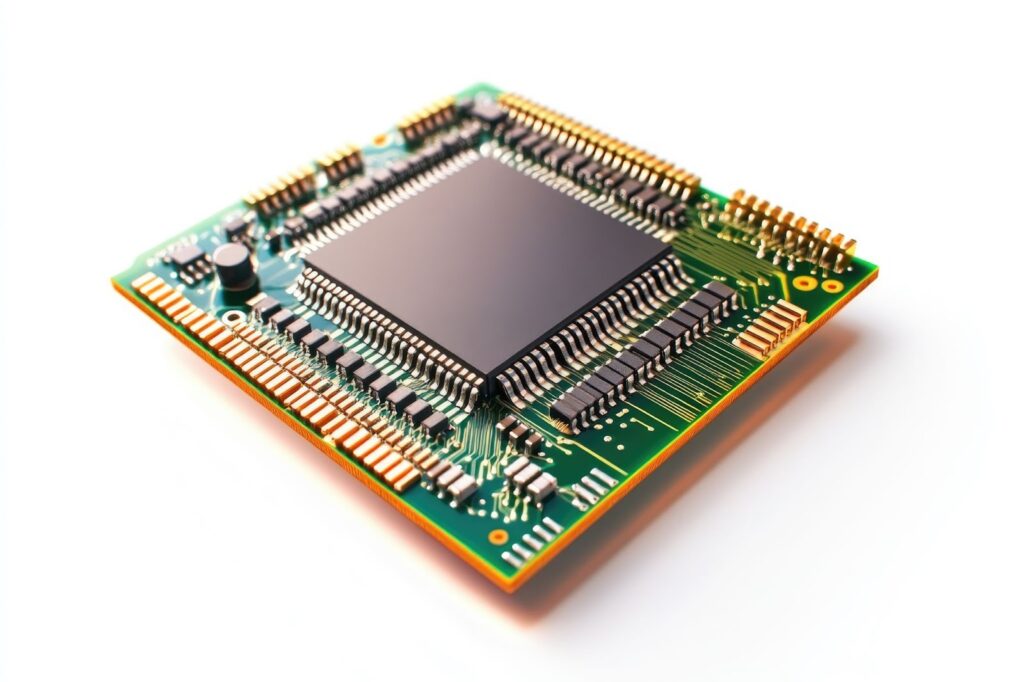
Image: The crucially important AI Chips – Flickr via Tim Reckman
To combat this, China has in return long been pouring billions into manufacturing chips domestically, with the government tapping tech giants Huawei and Alibaba to create alternatives.
And there have been some successes. In September, Chinese State Media reported that a new chip manufactured domestically by Alibaba can match the performance of Nvidia’s semiconductors while using less energy.
But aside from these success announcements, the key player remain vague as to how much they have actually progressed. “It’s a black box, they really don’t want people to know what the status is,” Thomas Derksen says. “But it’s clear Alibaba and Huawei are working like crazy to catch up.” But until they can, Lin Junyuan’s 20% chance statement seems to still have some backing.
Anyone in third place?
While China and the US are racing each other for AI dominance, the rest of the world has been busy too. India, for instance, has been pioneering its own sovereign models, most notably BharatGPT, heavily supported by the government. With a massive domestic market and an abundance of tech talent, Prime Minister Modi has repeatedly stressed his ambition for his country to become the world’s number three when it comes to AI.

Image: Prime Minister Narendra Modi at the AI Impact Summit he hosted in February (Narendra Modi Picture Gallery)
In Europe, Mistral AI has made headlines, with the French startup winning sizeable defense contracts in both Germany and France, as the EU pushes for greater AI independence.
In China’s backyard, the South Korean government has invested heavily in making its own “fully native” model, aiming to create an AI entirely independent from foreign models.
“The more important AI becomes and the more America and China advance, the more a lot of leaders are realising that they can’t be too dependent on either country,” Shao says. “The fear of AI-exploitation, of being a market while the money is made elsewhere is a real concern.”
But compared to China and the US, the industry seems in its infancy across the board. Bloomberg recently labelled India the “AI world’s most valuable unpaid intern” as the country is stellar at using AI models but still very much struggles at making them. In South Korea, three of the five companies shortlisted to make its “fully native” AI were found to still be using some code from foreign models, with executives saying that a fully decoupled model was “unrealistic.”
Europe seems even worse off: throughout the AI race, the United States have produced 40 foundation models, while China has developed 15. All of Europe combined has created just three. “And even European prestige projects like Mistral are far away from their American or Chinese counterparts,” Grace Shao says.
Do Countries Really Need Sovereign AI Models?
But does everyone really need to be building their own AI? “So many resources need to be in place locally to build an AI ecosystem from the bottom up,” Grace Shao says. “Trying to catch up to China or the US will take a long, long time for many countries, and it doesn’t make sense for most.” Instead, she says the conversation should not be framed as a race, but as an opportunity where countries can leverage their own strengths to build parts of their own tech stack, while still leaning on infrastructure led by the two superpowers.
Singapore has for example been courting both American and Chinese labs and attracting talent from both countries, who have then been building data centers in the small city state. Malaysia and Thailand are following a similar strategy. In South Korea, the government has invested $1.2 billion to enhance AI literacy in education after the “native model” disaster, aiming to become a talent hub for the technology.
In the end, Grace Shao says, many countries can find niches in this. “Outside of Asia, industry-heavy countries like Germany can for instance focus on AI-powered robotics or something like that, while countries in the gulf with an abundance of energy can focus more on utilizing that for AI” she says. “Each economy has its own advantages here.”
Thomas Derksen believes there also needs to be a change of mentality as well, particularly in Europe. “We need to acknowledge the fact that this technology has come to stay,” he says. “It’s a revolution and we’re in the middle of it. So we might as well get on with it and try to adapt.”
In the end, who’s winning this revolution right now depends on what winning means. The US still leads at the mere performance level. China is racing ahead on cost and scale, while the Americans maintain their biggest advantage, the chips. Meanwhile, for much of the world, the real question may not be who comes first- but where they can get a foot in the door.
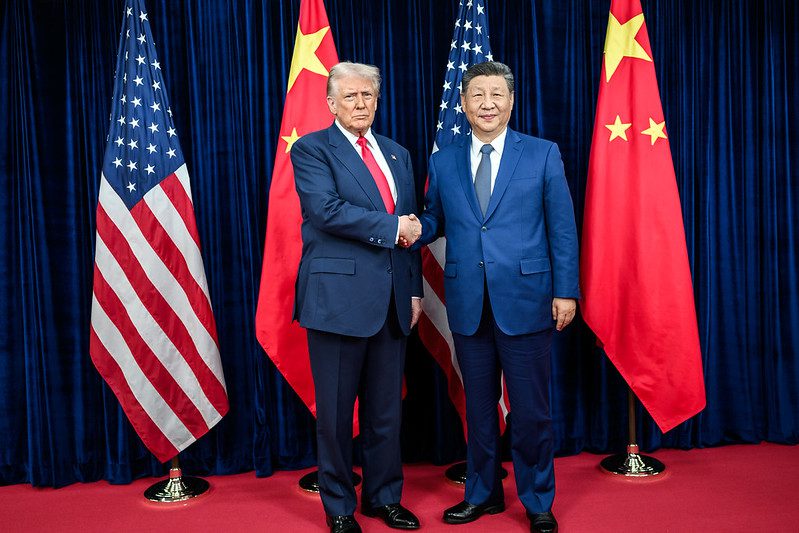
Featured Image via The White House / Daniel Torok