
Over the last year, a sweeping rebellious trend swept the nation after the UK Government proscribed the protest group, Palestine Action as a terrorist organisation, whereby it was placed in the same category as ISIS and Boko Haram. Palestine Action has a record of carrying out direct action at Israeli-owned arms factories in Britain. Notably, its members sprayed red paint on British warplanes at a Royal Air Force base, in protest of Britain’s role as “an active participant in the Gaza genocide and war crimes across the Middle East.”
In a more extreme instance, they attacked an officer with a sledgehammer, fracturing her back, during an organised break-in at a UK subsidiary of an Israeli defence firm. In her statement announcing the ban, Yvette Cooper claimed that the graffiti at the Brize Norton air base was part of “a long history of unacceptable criminal damage” carried out by members of Palestine Action.
As it stands, there are two primary pieces of statue that deal with, not just how those found to belong to proscribed terrorist organisations, but those who expressly show support for them: the Terrorism Act 2000 and the Terrorism Act 2006.
Under the Terrorism Act 2000, once an organisation is proscribed (officially banned by the Home Secretary): it is a criminal offence to belong to it (as per Section 11 of the statue), but it also an offence to invite support for it (Section 12). Section 12 was modified by amendments in 2019 led to the development that it remains an offence to express an opinion or belief that is supportive of a proscribed organisation and where the person is reckless as to whether the expression will encourage support for that organisation.
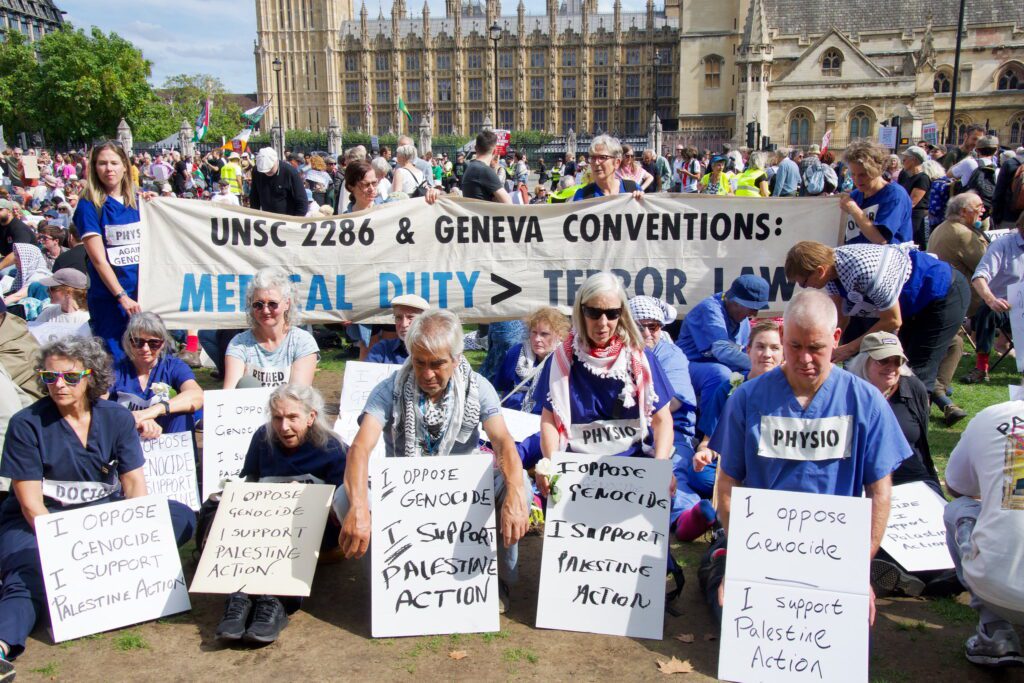
The caveat of “recklessness” has long been problematic for criminal prosecutions, and this case is no different. The amendment sets a high bar, that they were reckless as to whether it would encourage support and the expression was capable of encouraging support should invite a subjective test which should visit problems to every prosecution barrister involved. However, when the youth and elderly alike took to Westminster to protest against this proscription with cardboard box panels and placards inscribed with “I support Palestine Action”, that test is easily met. Put simply, there would exist very little reasonable excuse to avoid prosecution when a contextually-ready instance such as this one is present.
However, last week, the proscription was deemed unlawful and disproportionate by the UK Supreme Court, with judges citing that most of their activities had not reached the level, scale and persistence to be defined as terrorism. Yet that is not to say that the 2,500 people arrested for the crime relating to the protests have been resolutely vindicated – the Home Secretary, Shabana Mahmood said she would appeal against the ban.
Furthermore, this ruling only vindicates those who stood in solidarity with Palestine Action and will not have an effect on those directly engaged with the group – those who have broken into factories or disrupted supply chains on behalf of the group on account of the charges being criminal damage, and thus outside the ruling specific to terrorist support. Thus, the issue of raising placards – upon which a bulk of the arrests stemmed from – will no longer be unlawful as a result of Friday’s ruling.
This ruling, however, suggests a variety of constitutional implications which are directly in the scope of public interest. At first glance, it evidences the constitutional limits on executive power – proscription under the Terrorism Act 2000 is an executive Act by the Home Secretary, where courts traditionally show deference in national security matters. Thus, if the Supreme Court held the proscription unlawful and disproportionate, there is evident signalling of judicial willingness to scrutinise national security classifications; a limit on executive discretion under s.3 Terrorism Act 2000 (the power for the Home Secretary to proscribe an organisation if believed to be concerned with terrorism); a reinforcement of proportionality under Article 10 of the ECHR.
Furthermore, a redefined look on the actual definition of the act and courts’ view in future. In legal disputes, courts will often look previously to landmark cases that clarified any in distinction regarding the application of statue or its doctrine. Here, the Court implicitly clarified the statutory definition of s.1 TA 2000 and the serious threshold for proscription.
Thus, in an age where arable ground for protest is amplified by the forces of social media in the wake of perceived grievances (the riots of 2024, the rise of Reform) this may act as a significant landmark for what may be a coming period marked by unrest and protest, be it civil or peaceful. This ruling, so to speak, extends far beyond a moralistic campaign of vindicating those who were arrested in the interests of the “pro-Israel lobby and weapons manufacturers… nothing to do with terrorism”, in the words of the infamous group’s co-founder Hume Ammori, but rather a question of how future judges and courts tend to interpret terroris legislation on a case-by-case basis as a whole.
The ruling ultimately exposes how protest movements may oscillate between lawful dissent angle and terrorism classification depending on executive judgement, and so there are salient concerns about legal certainty regarding the future of protest movements entirely. Should Mahmood’s appeal fail, it may very well consequently be followed by pressures to repeal the proscription entirely. In turn, all pending s12 prosecutions may very well collapse, convictions in a state of precarious and detentions raising false imprisonment claims. If this is a lesson to any future Home Office in succession, it may very well be one of meticulously tightening evidential thresholds before proscriptions actually take place and the police becoming more readily adaptable to protest-ready strategies.
Featured Picture by: Indigo Nolan – Flickr (Creative Commons Licence CC BY 4.0