
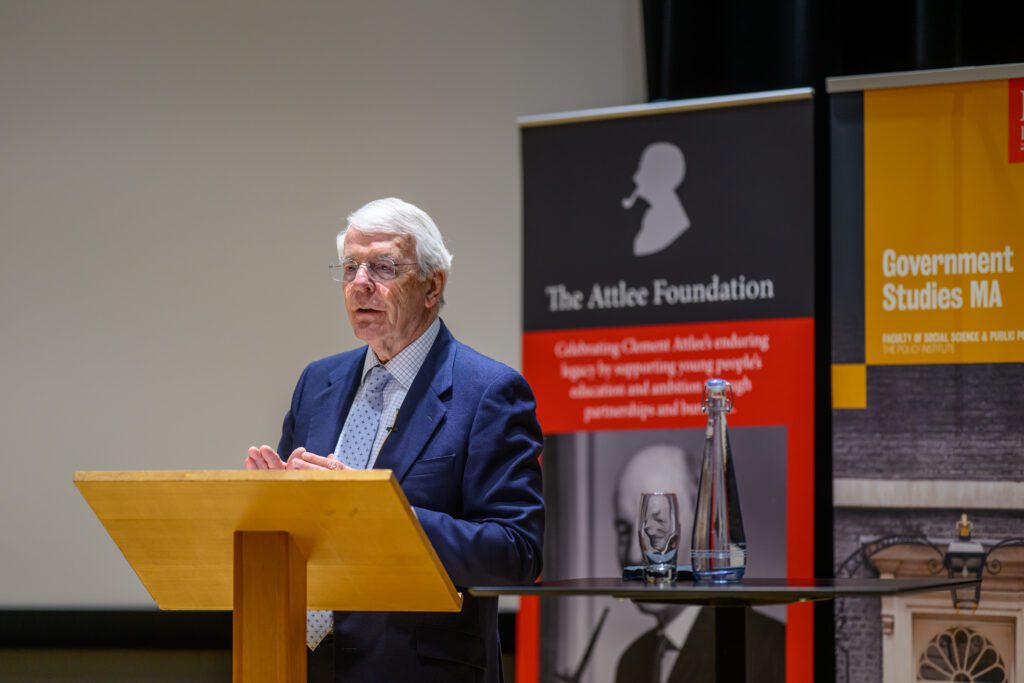
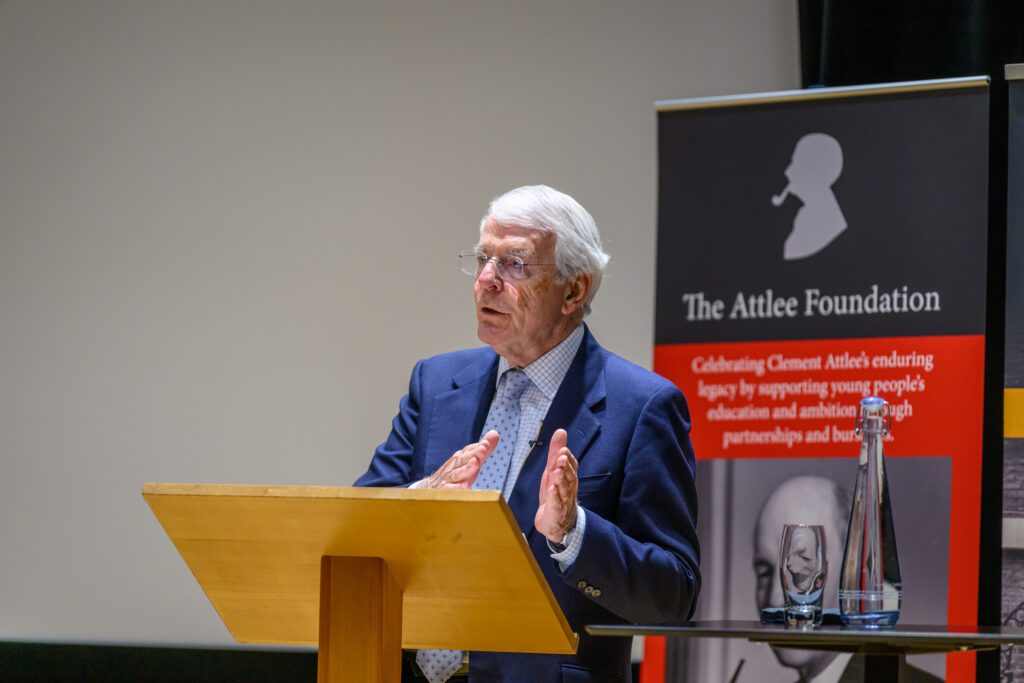
In a sweeping Attlee Foundation Lecture, former UK Prime Minister, Sir John Major argued that democracy is under pressure at home and abroad – and warned that if mainstream politics fails to deliver, the space may be filled by forces far less liberal, restrained or democratic.
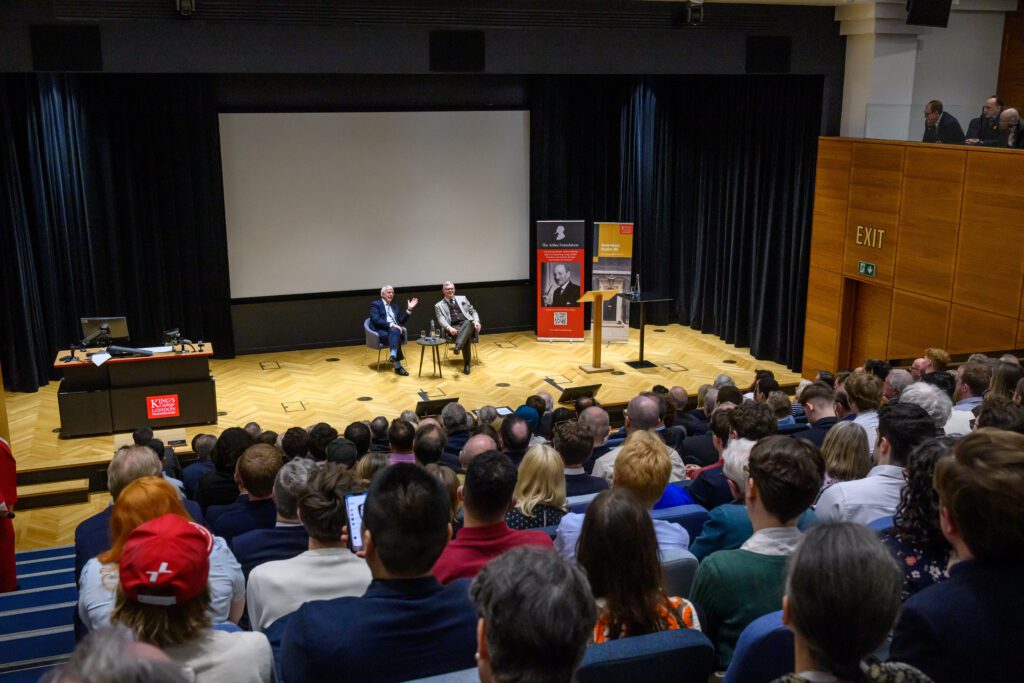
Delivering the Attlee Foundation Lecture at King’s College London, former Conservative Prime Minister, Sir John Major offered a grave but carefully argued reflection on the condition of British democracy, the health of the international order, and the risks of political complacency at a moment of deep public disenchantment.
He began by addressing the apparent incongruity of a former Conservative Prime Minister delivering a lecture in honour of Clement Attlee. In truth, he suggested, there was nothing strange about it at all. Attlee, Major said, deserved admiration not only for the scale of his achievement, but for his courage, public spirit, and willingness to put country before party. The NHS, his wider commitment to public service, and his example of serious political leadership all still matter today.
That opening was about more than historical courtesy. It set up one of the defining themes of the lecture – that democratic politics works best when opponents treat one another as opponents, not enemies. Major drew a sharp distinction between mainstream political rivalry, and the politics of grievance and division. The true enemies of democratic parties, he argued, are “populist insurgents” who seek to inflame resentment, exaggerate real social problems, and then blame minorities for them. That, he said plainly, is ugly politics and should have no place in Britain.
Mainstream politics must not lose its nerve
A central argument of the speech was that Britain’s mainstream parties have more in common than they often admit. Labour, the Conservatives and the Liberal Democrats may differ on philosophy, priority, and policy, but they all broadly want stronger public services, economic wellbeing, secure defence, good housing, flourishing education and decent employment. In a liberal democracy, those are not radical aspirations but basic expectations.
The problem, Major suggested, is that too often those expectations are not being met. That failure is feeding disenchantment, and disenchantment creates danger. When the main democratic parties collectively struggle to command even half of public support in the polls, that is not merely a momentary party-political setback. It is a warning sign.
Major’s message was not that democracy has already failed, but that it cannot be assumed safe simply because it is long established. Around the world, he noted, democracy has been retreating for years, with autocrats steadily weakening democratic protections to entrench their own power. Britain is not immune. If mainstream politics is cast aside too casually, he warned, the space created may not be filled by other democrats.
That was one of the most striking passages in the lecture. Any voter tempted to rejoice at the collapse of Labour, the Conservatives, or the Liberal Democrats, he implied, should think carefully about what might come next. If the old democratic structures fall away, the replacement may be harsher, less accountable, and far less tolerant.
Reform must mean more than rhetoric
Major also turned his attention to the growing overuse of the language of reform.
Politicians often invoke reform to signal seriousness and renewal, but the word itself can conceal as much as it reveals. Reform means change, he said. Change means upheaval. Upheaval provokes opposition.
His instinct was not anti-reform, but sceptical of empty reformism. Before tearing up longstanding systems, politics should first show that it can make progress on the everyday questions that shape people’s lives. He listed a series of practical issues that remain unresolved: whether tax levels deter savings and investment, whether planning rules are blocking housing, whether the benefits system discourages work, whether the triple lock should be better targeted, whether Parliament should take stronger action against the misuse of social media, and how Britain can pay for the armed forces it needs.
“Populists trade on grievance…and then blame those ills on minority groups of a different race or religion. It is ugly politics and it should have no place in our country.”
In other words, there is no shortage of substantive policy work to be done. Yet Major also argued that the political system itself needs attention. Politics, he said, has a “grubby underbelly” and is long overdue for a spring clean.
He questioned whether political funding is being corrupted when large donors, with no obvious qualification beyond wealth, receive honours or privileged access to ministers. Donations, he said, should be capped to guard against undue influence. He rejected the idea of an elected House of Lords, warning that it would challenge the primacy of the Commons and create constitutional confusion rather than improve scrutiny. But he did open the door to a serious debate about the voting system, arguing that first-past-the-post is producing increasingly distorted outcomes as voting patterns fragment.
He also made the case that MPs who defect to another party should be required to face their constituents again. Constitutionally, MPs are elected as individuals. Politically, Major argued, voters choose them as party representatives. On that basis, logic and decency suggest they should seek a renewed mandate if they cross the floor.
A blunt verdict on Brexit
Perhaps the most politically sensitive intervention of the evening came when Major addressed Brexit. To applause from the audience, he said openly that Brexit had failed to deliver on its promises, and that the economic consequences had been serious. The loss of trade and tax revenue, he argued, has done real harm to public finances, public services and living standards.
Unlike the recent intervention by the Mayor of London, Sir Sadiq Khan, [BH1] he stopped short of advocating a return to the European Union in the near future, acknowledging the political and practical barriers. But he was unequivocal that Britain should rebuild its relationship with its European neighbours as quickly and as comprehensively as possible.
This sat within a broader argument about Britain’s strategic position in the world. Leaving the EU, he said, weakened the UK’s ability to operate between the great European and American power centres at precisely the moment when the United States was becoming more distant and more unpredictable.
The international order is fraying
Much of the lecture focused on foreign affairs, and here Major’s tone became darker still. He lamented the erosion of the post-war rules-based system – built in the aftermath of the Second World War through institutions, alliances and habits of co-operation that helped make the world safer, freer and more stable.
The US, in his account, once stood at the heart of that benign order. He spoke warmly of the tradition that ran from Truman and the Marshall Plan through to the close trust he experienced personally with President George H. W. Bush during the first Gulf War. But he argued that this inheritance is now under severe strain.
President Trump’s approach, Major said, has introduced a harsher and more transactional American posture, one driven by slogans of self-interest and marked by tariff increases, hostility towards allies and a more dismissive attitude to Europe. Vice President Vance’s claim that Europe poses a greater threat to freedom than Russia was, Major said, both offensive and absurd.
“If diplomacy, consultation and co-operation break down, we will be moving towards the law of the jungle – and in such a world, no country is safe.”
He was especially critical of the treatment of President Zelensky in Washington, describing the Ukrainian leader as having been ambushed rather than supported. More broadly, Major warned that if diplomacy, consultation and co-operation continue to break down, the world risks moving towards the law of the jungle – a world in which might is right and weaker nations are left exposed to the will of the powerful.
He also used the lecture to question how secure NATO’s guarantees would remain if the United States became less willing to shoulder its traditional responsibilities. Europe, he argued, must become more self-reliant in defence while remaining firmly within NATO. That means higher defence spending, tougher choices, and far closer co-ordination on procurement and military readiness.
Britain must speak honestly to allies
For all his criticism, Major was careful not to suggest that Britain should distance itself from America. The transatlantic alliance, he said, remains essential to British security and intelligence interests. But partnership should not mean deference.
He criticised the growing tendency to tiptoe around President Trump for fear of causing offence. Sovereign nations that behave in that way, he warned, will eventually be treated “not as allies but as subordinates”. Britain should speak truth to the United States when it disagrees – privately, respectfully, but firmly.
That belief in moral seriousness and statecraft was refreshingly articulated throughout the lecture. Britain, he argued, must continue to stand up for what is right, not simply what is expedient.
A guarded optimism for Sir John Major
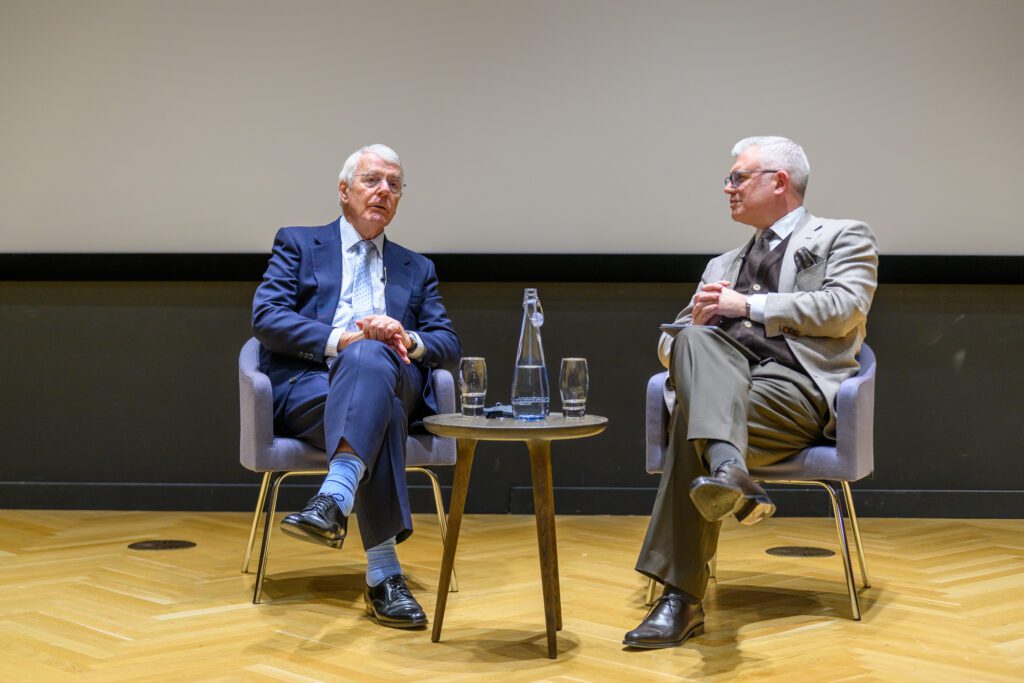
For all its warnings, the speech did not end in despair. Asked in the Q&A where optimism could still be found, Major pointed to “the young”. They have, he said, been badly treated in many ways – burdened by debt, priced out of housing, and deprived of the stability earlier generations took for granted. Yet they are also more open, less prejudiced, more internationally minded, and more willing to embrace shared action on common problems.
That, for Major, is where hope lies.
His lecture cannot be seen a simple lament for a lost political culture or a fading international order. It was a inspirational call for democratic seriousness – for mainstream politics to recover its sense of service, for Britain to repair trust at home, and for liberal democracies to recover the confidence to defend their values abroad.
Prosperity and democratic stability do not survive on sentiment alone. They require work, honesty, co-operation and courage. If the UK and its allies fail to provide those things, others with darker intentions will be only too ready to fill the void.

This annual Attlee Lecture was organised by The Strand Group and the Attlee Foundation.