
Across the bustling streets of Dhaka and the quiet villages of the delta, more than 127 million Bangladeshis are today participating in an election that many describe as the most significant since the nation’s independence. This is the first general election since the monumental “July Revolution” of 2024, a period marked by a bloody crackdown on protesters that ultimately led to the collapse of the Awami League government. For the first time in nearly two decades, voters express a sense of genuine agency, yet the path to this ballot box has been paved with unprecedented legal drama, international tension, and a radical restructuring of the state.
The Anatomy of a Collapse: The 2024 Revolution
The current political landscape is the direct result of the Gen Z Uprising in mid-2024. What began as a student-led protest against a discriminatory civil service quota system transformed into a massive, national movement against the 15-year rule of Sheikh Hasina. The state’s attempts to suppress the dissent led to a staggering loss of life; the United Nations has estimated that roughly 1,400 people were killed during the crackdown.
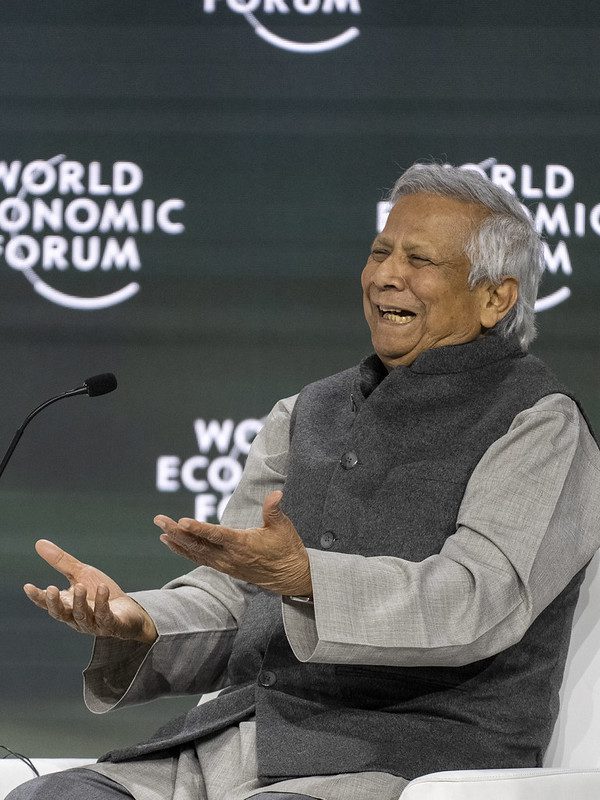
The subsequent public fury forced Hasina to flee by helicopter to India on August 5, 2024. In the aftermath, the country turned to Nobel Peace Prize laureate Muhammad Yunus to lead an interim government. His mandate has been focused on “cleaning the house”, overhauling the police, the judiciary, and the election commission, before returning the country to civilian rule.
A Nation Judging Its Past
The transitional period has been defined by a series of legal reckonings aimed at the former ruling elite. Most notably, a Bangladeshi court has sentenced Sheikh Hasina to death in absentia for crimes against humanity committed during the 2024 crackdown. Additionally, she has been handed a combined 21-year prison sentence across separate corruption cases.
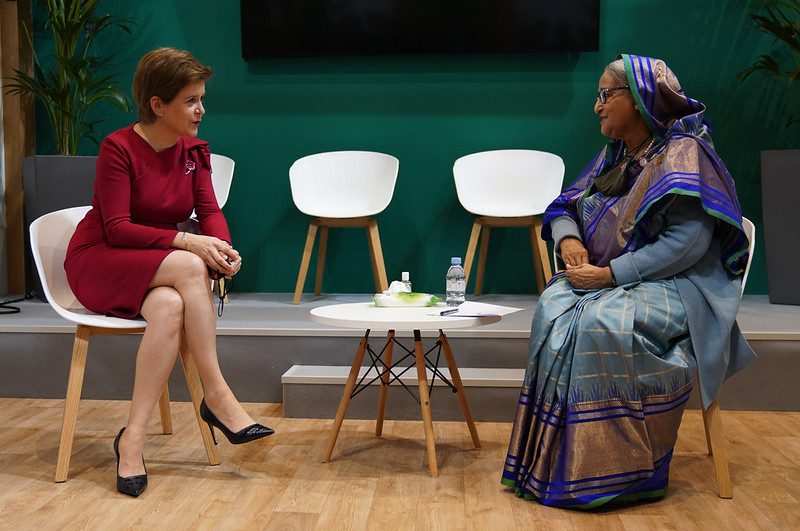
Image: Former Scottish First Minister Nicola Sturgeon meets with Bangladesh Prime Minister Sheikh Hasina at the COP26 Women’s Climate Leadership Event – Scottish Government
The legal fallout has also reached the United Kingdom. Tulip Siddiq, a prominent British Labour MP and niece of the deposed leader, was recently sentenced to a two-year prison term by a Dhaka court. The charges involve allegations of corruption and influence-peddling related to government land allocations. This judgment, delivered in her absence, is not recognised by the UK government. Siddiq has dismissed the entire proceeding as a politically motivated and contrived attempt to target her family.
The Return of the BNP and the End of an Era
This election marks a major transition for the Bangladesh Nationalist Party (BNP). On December 25, 2025, Tarique Rahman, the son of former Prime Minister Khaleda Zia, returned to Dhaka after 17 years in exile in London. His return was a massive symbolic event for the party, occurring just days before his mother, Khaleda Zia, passed away at the age of 80 on December 30, 2025.
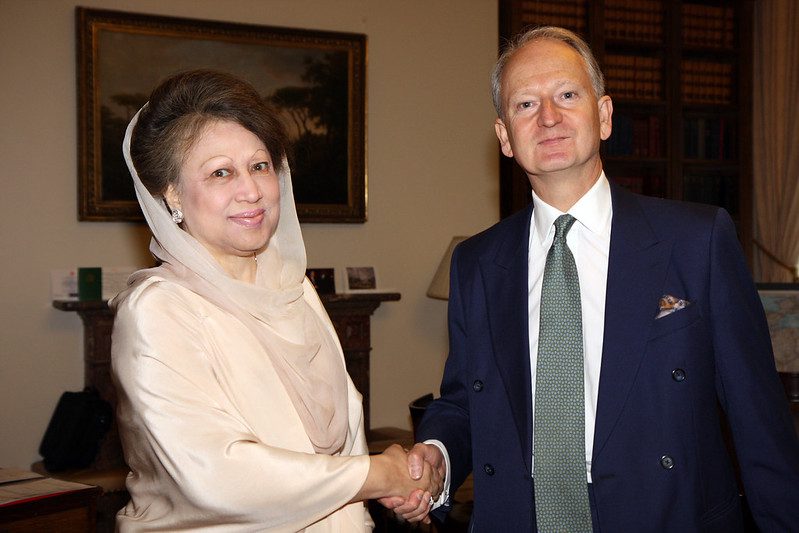
Image: Former Prime Minister Khaleda Zia meets Former Foreign Henry Bellingham – FCDO
Rahman is now the frontrunner to be the next Prime Minister. He has pledged a platform of “Democratic Renewal,” which includes:
- Restoring the independence of the judiciary.
- Revitalising the nation’s ailing economy.
- Modernising state infrastructure to prevent future authoritarianism.
Opposing him is a resurgent 11-party alliance led by Jamaat-e-Islami, the country’s largest Islamist party. Once banned under the Hasina regime, the group has regained significant political ground. While they appeal to a conservative base in a nation that is 90% Muslim, their rise has sparked deep-seated fears among women and religious minorities regarding the potential erosion of secular protections.
The July Charter: A Referendum for Reform
Beyond selecting local representatives, citizens are casting a second ballot in a national referendum. This vote centers on the “July Charter,” a blueprint for sweeping constitutional changes intended to serve as “guardrails” against future autocracy. The proposed reforms include:
- Bicameralism: Moving from a single-chamber parliament to a two-house system by adding an Upper House of 100 seats to the Jatiya Sangsad.
- Term Limits: Restricting any individual from serving as Prime Minister for more than 10 years (two five-year terms).
- Caretaker System: Reinstating an independent interim body to manage all future elections, ensuring neutrality
Economic and Social Headwinds
The winner of this election will inherit a nation in economic distress. Bangladesh’s vital garment export industry, a cornerstone of the economy, saw exports drop by 2.6% in the latter half of 2025 due to persistent unrest. Furthermore, inflation remains a major burden for the working class, sitting at 8.58% as of January 2026.
Global eyes are fixed on Dhaka, with roughly 500 international observers from the European Union and the Commonwealth monitoring the process. As mounted police patrol the polling stations with banners proclaiming a safe voting environment, the atmosphere is a mix of festive hope and cautious anxiety. For millions of young voters who have never seen a truly transparent election, today is the ultimate test of whether the “Gen Z Uprising” can be successfully codified into a stable, lasting democracy.
Featured Image via The World Bank / Faruk Pinjo