

Henry Snowden
Polling Correspondent – PoliticsUKThis article sets out my projection for the upcoming May local elections, based on a proprietary ward-level election model. The model incorporates national polling averages, demographic weighting, historical ward behaviour, and turnout differentials to estimate projected council vote share across 128 authorities.
This is not a prediction of seat totals, but rather a projection based on a vote share assessment of the underlying political landscape of the local elections as it currently stands in mid-February. And on that basis, the projected result is one of fragmentation, volatility, and extraordinary pressure on the Labour Party and its leadership’s ability to continue.
Local Election Test – Reform UK
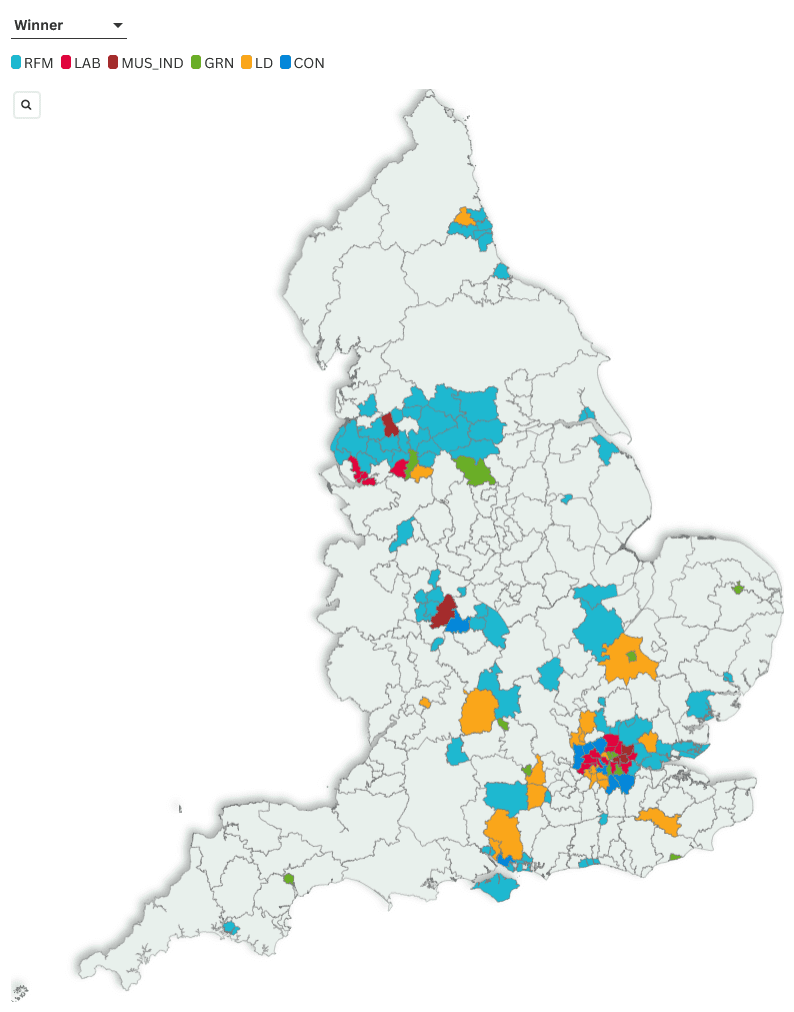
Reform is overwhelmingly favoured to win the highest national vote share in this year’s local elections. The Party has consistently polled between 26–32 per cent since May last year, maintaining a clear lead over its competitors.
Ahead of the 2024 elections, there was considerable scepticism about whether Reform could translate polling strength into actual votes. Historically, “Faragist” vehicles have sometimes underperformed at the ballot box. In last year’s projection, however, I argued that Reform would not only meet polling expectations but exceed them – driven by three structural advantages: an unpopular Labour Government, a Conservative 2021 voter base demographically vulnerable to Reform, and a measurable turnout enthusiasm advantage. While not all these conditions are as strong today, Reform currently has an even greater advantage than they did last year – they have now established themselves as the dominant force on the right of British politics. That institutional consolidation greatly reduces the risk of polling underperformance, and as long as they are in the same ballpark as their current polling figures, they will have a dominant night, which is why the model projects Reform to win the most votes in 69 of the 128 councils analysed. Strength will be especially pronounced in formerly “Red Wall” authorities such as Hartlepool and Wigan, where comfortable vote-share pluralities are likely.
The Green Party
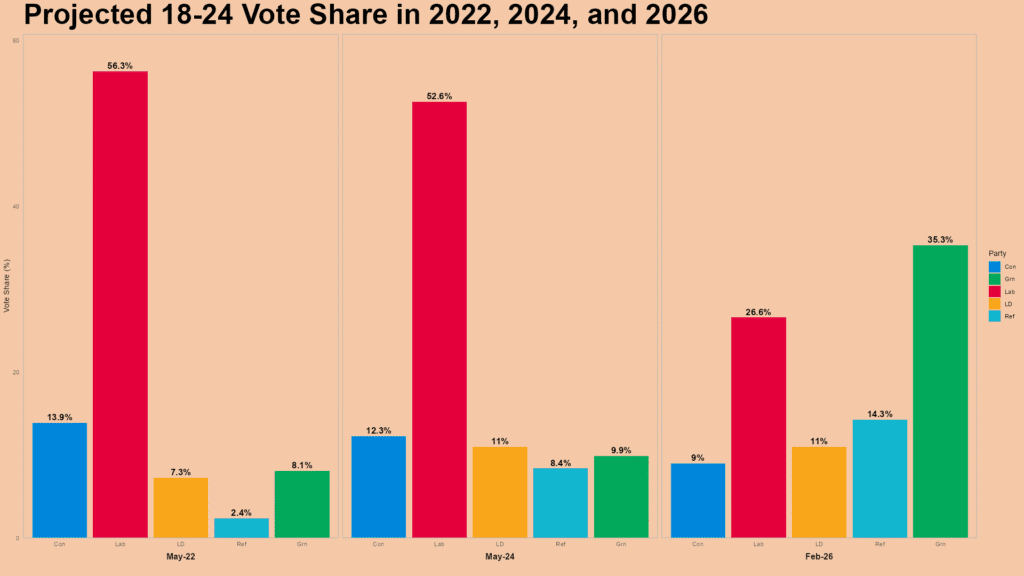
The Green Party is also on track for a significant advance. Following its leadership change, the Party has risen to record national polling levels (13–16 per cent), positioning it for its strongest ever local election performance in both vote and seat share. However, headline polling obscures a critical structural feature: Green support is highly age-concentrated. Aggregated data shows a clear lead among younger voters. This has a significant geographic implication, which is that the Green Party is likely to overperform in university towns and younger urban centres: Sheffield, inner London, and Manchester being prime examples. Furthermore, there are indications of improved performance among Muslim voters. While this trend is uneven and highly localised, and recent elections show substantial variance, there is good early evidence that points to this demographic trend further boosting Green prospects in certain metropolitan areas.
The Liberal Democrats
The Liberal Democrats are projected to consolidate in most districts they already hold and continue advancing in areas where they have built local infrastructure over recent cycles. However, they face new structural pressure. The simultaneous rise of Reform and the Greens compresses a key portion of the traditional Liberal Democrat coalition. Historically, the Party benefited from general dissatisfaction with the two largest parties. In a five-party competitive environment, that protest space is fragmented. This is likely to show the most effect in places like Hull, where its strong demographic favourability to Reform (low education attainment and high social deprivation) leads to the loss of a former important core “protest vote” coalition. A similar dynamic is likely to be at play (albeit to a smaller degree) among younger people in university areas as the Greens will likely hoover up support from disenchanted progressives, who may have otherwise gone to the Lib Dems. Nevertheless, the Lib Dems are still very likely to hold onto many of their more affluent, “high homeownership districts” such as South Cambridgeshire – recent electoral trends have been so positive in these sorts of areas, and they don’t face the same sort of demographic alignment challenge.
The Party has increased its seat share in nearly every local election since 2016, after heavy coalition-era losses. This projection does not suggest a collapse, as they are projected to win the most votes in 19 councils, four more than they currently “hold”. Nevertheless, it does indicate that their long post-coalition upward trajectory may plateau under intensified multi-party competition.
The Conservatives
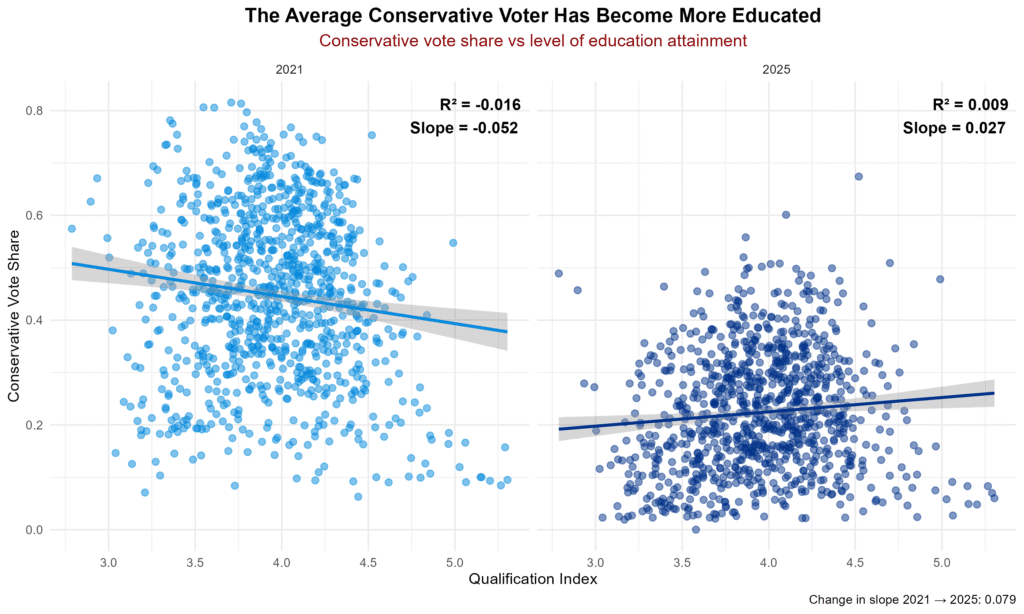
The Conservatives are projected to experience another significant vote share decline. Current polling (~19 per cent) is well below their 2021 (~42 per cent), 2022 (~34 per cent), and even 2024 (~23 per cent) levels.
However, the political impact may not feel as catastrophic as last year. Many of the councils voting this year were last contested in 2022 or 2024, meaning the baseline is already depressed.
The central electoral dynamic remains the competition with Reform. Areas where the Conservative 2021–2024 vote was heavily working-class (e.g. Walsall) are likely to see the largest swings away. By contrast, authorities over-indexed toward affluent Conservative voters (e.g. Kensington and Chelsea) should experience smaller declines.
Interestingly, because Labour’s projected decline is steeper still, the Conservatives are projected to top the poll in councils previously won by Labour, such as Wandsworth and Barnet. In short, the primary electoral takeaway for the Conservatives is likely to be many losses throughout the country, which turn out to be politically tolerable for the leadership due to relatively fewer losses compared to Labour and the previous year, as well as the potential of “mirage gains”.
Muslim Independent Groupings
An under-discussed but increasingly significant force in local politics is Muslim independent groupings. Since 2024, these candidates have achieved sustained success in high-Muslim-population authorities: strong metropolitan borough performances in Oldham and Blackburn with Darwen (2024), gains in Preston at Lancashire County Council (2025), and continued by-election wins thereafter. While some have speculated that declining salience of Gaza could reverse this trend, there is currently limited evidence of meaningful retrenchment. Accordingly, this projection is cautiously bullish on continued success in relevant wards, with the critical caveat that this projection is not based on polling data as no good data exists on the topic.
Labour
If there is no major shift in political conditions, the defining story of this election will be Labour’s projected collapse.
Labour is currently polling at roughly 20 per cent, a twenty-first-century low. Keir Starmer’s approval ratings are deeply negative at around -47 per cent. More structurally, the Party is being squeezed from all directions: Reform in working-class areas, the Greens among younger urban voters, Muslim independents in areas with large Muslim populations, and Liberal Democrats in affluent districts.
The model suggests Labour’s geographic base has narrowed dramatically. Of the 128 councils analysed, Labour previously won the most votes in 82. Under current conditions, that number falls to just 14. Currently, the Party is projected to hold only in authorities where it previously achieved overwhelming margins (for example, Halton, where Labour exceeded 68 per cent in 2024),
and parts of central London with dense concentrations of professional middle-class voters, where decline appears more limited.
While it remains unlikely, it is not mathematically impossible that Labour fails to top the poll in any council. That would represent a political earthquake.
Limitations and Qualifications
Several important caveats apply
- This projection was completed in mid-February (prior to the Gorton and Denton by-election). Given current volatility, significant movement is possible.
- It models a “snap election now” scenario, not a definitive May forecast.
- Candidate lists are not finalised. The model assumes Reform, Conservatives, Labour, Liberal Democrats, and Greens stand everywhere. This will not be the case.
- Independent and hyper-local parties are not comprehensively modelled (with partial exception for Muslim independent inference).
- Due to widespread boundary changes, this projection estimates council vote share, not seat share.
- Six county councils and the newly created East and West Surrey authorities are excluded.
- Polling figures cited are aggregate averages.
- View our methodology here
As always with modelling, this is a probabilistic assessment of current conditions, not a guarantee of outcome.
This article features in the new edition of ChamberUK. Our parliamentary journal.