
It has been over a week since hegemons Israel and the USA have reignited tensions that have been nearing boiling point for years. A joint effort of attacks on Iran came after Israel had continuously stoked fears that its Middle Eastern neighbour was preparing to construct a nuclear weapon.
The overarching convention which determines legality of armed attack between states is Article 2(4) of the UN Charter, which prohibits states from using force against the territorial integrity or political independence of another state. The two widely accepted exceptions are:
- UN Security Council authorisation under Chapter VII
- Self-defence under Article 51 if an armed attack occurs
For self-defence to be lawful, most scholars say it must satisfy:
- Armed attack (or at least an imminent one)
- Necessity, meaning force is required to stop the threat
- Proportionality, meaning the response adequately reflects what is needed to repel the attack.
The Standard of Imminence
The Israeli president, Isaac Herzog, told BBC Radio 4’s Today programme the fact that Iran was “planning a bomb” was enough to justify the attacks. Under Article 51 of the UN Charter there is a right to self-defence in response to an armed attack. A broader interpretation of international law has been that a state has a right to use force in response to an “imminent threat.” Thus, “imminence” is the key here.
Traditionally, international law has drawn on the 19th century Caroline formulation, which requires a threat to be “instant, overwhelming, leaving no choice of means and no moment for deliberation.” Under this standard, the bar for anticipatory self-defence is extremely high.
Does Iran Pose a Threat?
Currently, Iran harbours zero nuclear weapons. This is not simply a baseless claim: Iran is bound by the Non-Proliferation Treaty (NPT). Essentially, the treaty is a bilateral agreement whereby signatory states “agree never to acquire nuclear weapons and the NPT nuclear-weapon states in exchange agree to share the benefits of peaceful nuclear technology and to pursue nuclear disarmament aimed at the ultimate elimination of their nuclear arsenals.”

Image: Israeli Prime Minister Benjamin Netanyahu at an officers’ graduation ceremony – Kobi Gideon / GPO
Israel, since its inception in 1948, has refused to sign. Further, Iran routinely submits to inspection by the International Atomic Energy Agency (IAEA), a UN-related international organisation based in Vienna that monitors nuclear programmes to ensure nuclear materials are not diverted from peaceful uses to nuclear weapons. Israel, on the other hand, refuses to submit.
While Iran has expanded uranium enrichment in recent years, enrichment alone does not constitute a nuclear weapon. The determinable, crucial step (weaponisation) remains difficult to verify. Thus, it can be argued that the existence of a potential future capability does not satisfy the Caroline standard of an imminent armed attack.
However, supporters of the strikes have argued that the speed with which highly enriched uranium can potentially be converted into a weapon compresses the traditional understanding of imminence. In this light, the test for imminence is most salient. Without proper evidence of a potential nuclear weapon to be sure-fire ready for deployment as opposed to mere preparation, the notion that the attacks can be justified on the grounds of imminence seems surely thin.
The Necessity Component
There exists a variety of avenues in which the two nations could have attempted before violent means. For example, diplomacy and nuclear agreements: for instance, the Joint Comprehensive Plan of Action or sanctions and monitoring regimes (as mentioned, Iran already submits to this). This opens discussions regarding the “necessity” component of assessing whether attacks were truly legal. The requirements of necessity demand that force be used only when no reasonable peaceful alternatives remain or were already exhausted to no avail.
Proportionality: Were the Strikes Limited?
To assess the proportionality element, the targets and casualties of this operation are particularly salient. As mentioned, even if a threat were considered imminent, international law requires that the response be proportionate. Strikes must be limited to what is necessary to neutralise the threat rather than punish or deter a rival state more broadly.

Image: President Donald Trump and Israeli Prime Minister Benjamin Netanyahu speak in the Diplomatic Reception Room before a dinner – The White House / Daniel Torok
Reports indicate the strikes have targeted a wide range of military, political and economic infrastructure, not just nuclear facilities. The operation launched by US-Israeli forces was far more extensive than the limited intervention last year. Early strikes reportedly targeted senior Iranian leadership and security infrastructure: senior Iranian officials were killed, including military leadership and the country’s Supreme Leader (Ayatollah) during the opening strikes. Iranian naval vessels and minelayers were destroyed near the Strait of Hormuz, as well as drone factories and missile-related infrastructure have also been targeted. These are all types of targets typically cited by the US and Israel as legitimate military objectives.
Reports also indicate substantial civilian harm: more than 1,200 people have been killed since the campaign began, while humanitarian organisations report damage to thousands of residential buildings and dozens of healthcare facilities. Particularly controversial was a strike on a girls’ school that reportedly killed over a hundred civilians. President Trump denies his involvement in the attack, instead claiming it was Iran’s own missile which hit the school.
International Humanitarian Law and the Geneva Conventions
Even if the strikes were considered lawful under the right of self-defence, they must still comply with the rules governing the conduct of hostilities under international humanitarian law. These rules are codified in the Geneva Conventions and their additional protocols.
Two principles are particularly relevant:
- Distinction: This requires parties to a conflict to differentiate between military objectives and civilian objects. Attacks may only be directed at legitimate military targets, such as military facilities, weapons depots, or command structures. Civilian infrastructure, including homes, schools and hospitals, cannot be intentionally targeted.
- Proportionality: Closely related is the principle of proportionality. Even when a target is a legitimate military objective, an attack may be unlawful if the expected civilian harm would be excessive in relation to the concrete and direct military advantage anticipated.
If such sites were struck intentionally, they would almost certainly constitute violations of international humanitarian law. If they were damaged incidentally while attacking nearby military targets, the legality would depend on whether the expected civilian harm was considered excessive at the time of the attack.
Conclusion
Ultimately, assessing proportionality is notoriously difficult in real time and often depends on information available only to military planners. Nevertheless, the scale of civilian harm reported in the strikes is likely to intensify scrutiny from international lawyers and human rights organisations.
The legality of the US and Israeli strikes on Iran remains deeply contested under international law. While both states have framed their actions as necessary in the unwavering pursuit of self-protection and long-term peace, the legal threshold for anticipatory self-defence is exceptionally high. The traditional standard of imminence requires a threat that is immediate and unavoidable, and the available public evidence that Iran was on the verge of deploying a nuclear weapon appears limited.
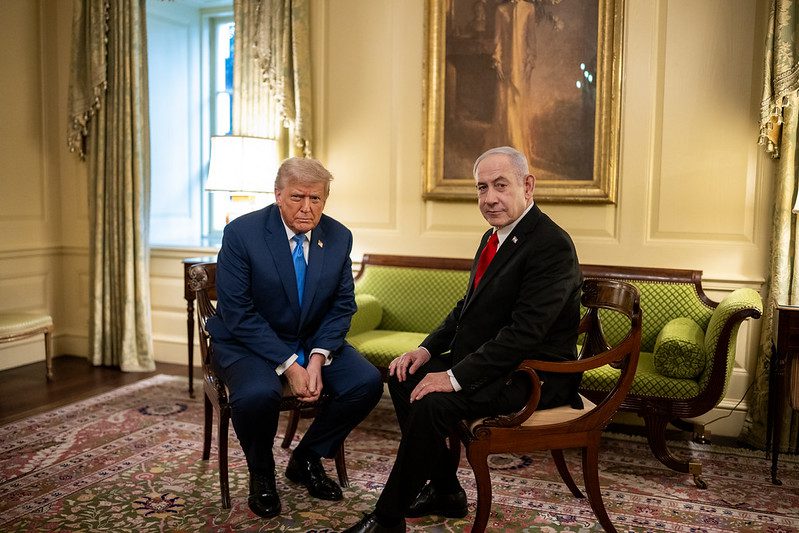
Image: President Donald Trump and Israeli Prime Minister Benjamin Netanyahu speak privately in the Vermeil Room before a dinner – The White House / Daniel Torok
Evidently, questions regarding necessity appear paramount. Diplomatic mechanisms, inspection regimes and international agreements designed to constrain Iran’s nuclear programme have existed for years, raising doubts over whether the use of force was truly the only viable option available.
Even if the strikes were considered legally justified under the right of self-defence, their conduct must still comply with international humanitarian law. Reports of extensive civilian casualties and damage to residential areas, hospitals and schools place the proportionality of the operation under serious scrutiny. In practice, the legality of such actions is rarely determined in the immediate aftermath of conflict; rather, it is formulated through long-term efforts and debates through international institutions and historical judgement.
For now, the strikes occupy a legally ambiguous space: both in the realm of being highly contested by legal scholars and world leaders alike, but also torn between the tension which exists within international law over how states respond to emerging security threats in an increasingly unstable terrain.
Featured Image via The White House / Daniel Torok