
A new investigation has revealed that dentists in England have returned more than £900 million to the Government over the past two years for NHS dental work that was contracted but never delivered.
The figures, uncovered through analysis of NHS accounts, show that in 2024–25 alone nearly £450 million was returned, while £480 million was handed back the previous year. In both years, more than 40 per cent of dental practices underdelivered against their NHS contracts.
The sums represent roughly one pound in every seven allocated to NHS dentistry.
The financial mechanism behind this is known as “clawback”. Under the current NHS dental contract, practices agree to deliver a set volume of treatments each year. If they deliver less than 96 per cent of that contracted work, NHS England recoups part of the funding.
The growing scale of clawback reflects a system increasingly struggling to deliver care. Many practices now prioritise private patients because NHS payments often fail to cover the cost of treatment.
As the British Dental Association (BDA) has argued, the financial model leaves some dentists losing money on routine NHS procedures.
The impact is increasingly visible to patients. Surveys suggest that more than one fifth of people in England are unable to access NHS dental care when they need it, with waiting lists stretching years in some areas.
For many families, dentistry has begun to feel less like a public health service and more like a private commodity.
CMA Launches Investigation Into Private Dentistry
Against this backdrop, the Competition and Markets Authority (CMA) has launched a formal investigation into the private dentistry market.
The regulator is examining:
- The transparency of pricing
- Whether patients are given clear information on treatment options
- How easily patients can compare costs between providers
The CMA has warned that many patients may be uncertain about costs, availability and their entitlement to NHS treatment.
The investigation follows evidence that private dental fees increased by up to 22 per cent between 2022 and 2024.
In some cases, dentists can now earn twice as much treating patients privately compared with delivering the same procedures under NHS contracts.
The CMA’s intervention signals a growing concern that the shift towards private dentistry is not simply a matter of individual practice choices but may represent a structural change in the market.
If confirmed, it would represent one of the most significant shifts in the UK’s dental care model in decades.
Government Acknowledges Structural Problems
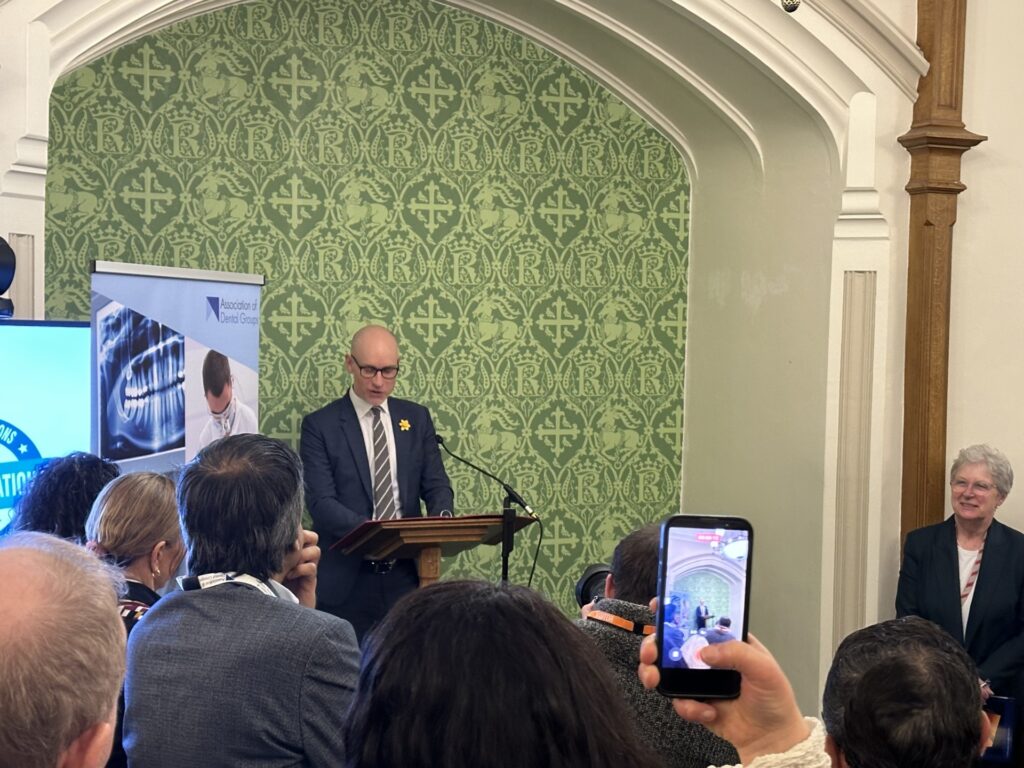
Speaking at an event in the House of Commons last night marking the 15th anniversary of the Association of Dental Groups (ADG), Stephen Kinnock MP, Minister of State for Care, acknowledged the depth of the challenge facing NHS dentistry.
He told the audience that the Government inherited a system under severe pressure.
“We are under no illusions about the state of dentistry that we inherited when we came into office,” he said. “We all know that we must do better for patients.”
Kinnock emphasised that access to dental care has become one of the most prominent concerns raised by the public, and that the Government is committed to reforming the system.
“We cannot, and we will not, be part of a society where people resort to DIY dentistry or where dentists leave the NHS because it does not pay to be there.”
The minister pointed to a series of short-term measures designed to stabilise the system while longer term reforms are developed.
These include:
- Increasing urgent care payments to dentists from £42 to £75 from April
- Introducing new treatment pathways for complex patients with payments between £250 and £700
- Expanding dental workforce routes, including overseas registration examinations
Kinnock also confirmed that fundamental reform of the NHS dental contract will be delivered before the end of the current Parliament.
“We want a contract that matches resources to need, improves access, promotes prevention and rewards dentists fairly.”
Underspend and Access: A Systemic Mismatch
One of the most striking findings highlighted by the minister was the existence of significant unused funding in the dental system.
When the current government took office, around £400 million of the NHS dental budget had gone unspent, despite rising demand for care.
Kinnock said one of his first instructions to officials was that every pound allocated to dentistry must be spent on dentistry.
“Demand for NHS dentistry was going through the roof, and yet there was £400 million underspent.”
Since then, the underspend has reportedly fallen significantly.
According to the Department of Health and Social Care, 1.8 million additional courses of NHS dental treatment were delivered between April and October 2025 compared with the same period before the general election.
Nearly half of those treatments were delivered to children.
However, ministers acknowledge that these measures alone will not solve the structural problems facing the sector.
Prevention and Public Health
Alongside contract reform, the Government is also emphasising prevention and population health.
Among the measures highlighted by Kinnock were:
- Distribution of four million toothbrushing packs to children in deprived areas through a partnership with Colgate Palmolive
- Expansion of water fluoridation schemes in the North East, reaching an additional 1.6 million people
- Strengthening of the Soft Drinks Industry Levy and new baby food standards
These initiatives reflect a broader shift within the NHS towards prevention and early intervention.
As Kinnock put it: “Dentistry must be part of the transition from analogue to digital and from treatment to prevention.”
The Ageing Population Challenge
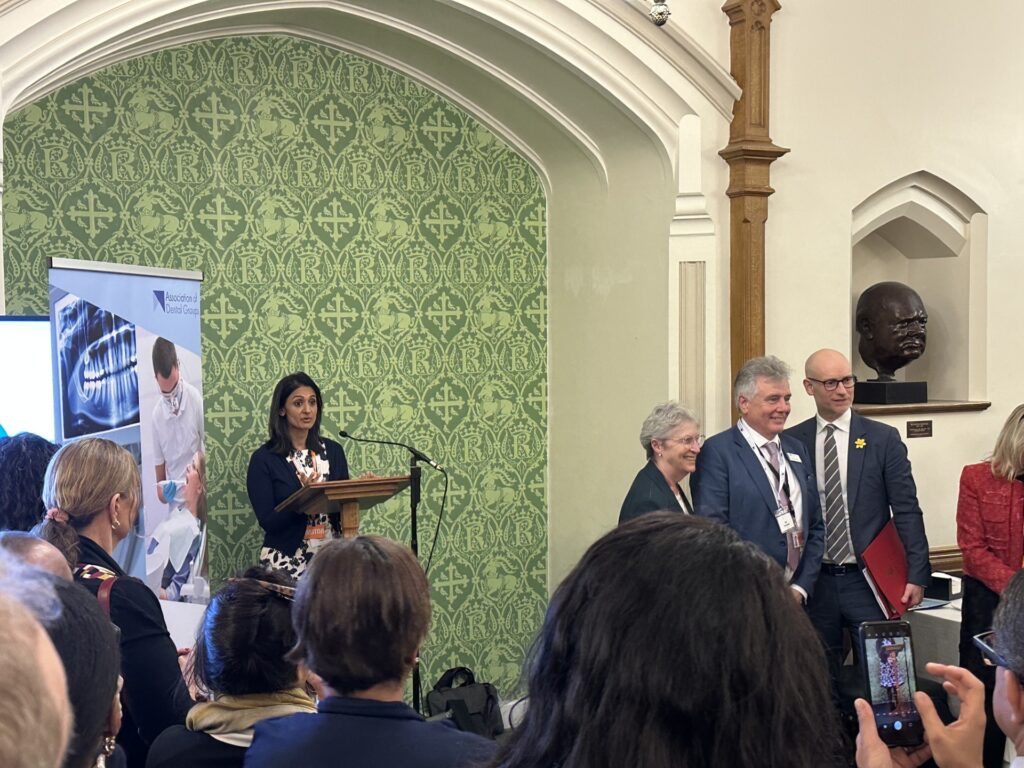
Following the minister’s remarks, Rakhee Patel, Deputy Chief Dental Officer for England, outlined another major pressure shaping the future of dentistry: the ageing population.
Drawing on two decades of experience delivering domiciliary dental care, Patel described the growing complexity of oral health needs among older patients.
“We know that older people are increasingly keeping their own teeth,” she explained.
“But they are often retaining teeth alongside complex treatments such as implants and restorative dentistry.”
While this reflects advances in dental care, it also creates new challenges.
Older patients frequently require ongoing maintenance and support to preserve those treatments.
Patel warned that the system must adapt rapidly to what she described as the changing demographic reality.
“Life expectancy is increasing, but so too is disability life expectancy. Our goal must be to minimise the time people spend living with disability and maximise the years spent in good health.”
Poor oral health in older people is not only a dental issue. It is closely linked to broader health outcomes, including:
- Respiratory disease
- Cardiovascular conditions
- Diabetes
- Malnutrition
Frailty is a particular concern.
“Around seventy per cent of frailty is related to malnutrition,” Patel said, “and a large part of that relates to whether people are able to chew effectively and eat a varied diet.”
To respond effectively, she argued, dentistry must become more proactive and integrated within the wider health system.
Key priorities include:
- Earlier intervention and anticipatory care
- Better integration between general practice and community services
- Improved use of population data to identify vulnerable patients
“Within the NHS we already know where many vulnerable individuals are,” Patel noted.
“We should be using that data to prioritise care before oral health deteriorates.”
Technology and the Future of Dentistry
The House of Commons event also explored how digital technology and artificial intelligence (AI) could transform the dental sector.
Opening the discussion, Neil Carmichael, Executive Chair of the Association of Dental Groups, emphasised the role technology could play in improving access and care.
“Technology, artificial intelligence and teamwork all matter. Together they will make dentistry even more significant, more important and, crucially, more beneficial to patients.”
The ADG launched a new whitepaper at the event examining the future of dentistry over the next fifteen years.
According to Carmichael, the sector faces three major structural shifts.
“The next fifteen years will be shaped by tectonic changes in demographics, technology and workforce.”
He said the discussions with government and NHS leaders demonstrated growing recognition of the need for reform.
“It was significant for our guests to hear from Stephen Kinnock on prevention measures and prioritisation of urgent care, and from Rakhee Patel on the need to prepare for dentistry’s silver tsunami.”
Despite the current challenges, Carmichael believes innovation will help transform the sector.
“With smart use of AI and digital technology, plus full deployment of the skill mix across the dental workforce, the next fifteen years of dentistry can be bright.”
A System at a Crossroads
The events of the past week highlight how rapidly dentistry has moved to the centre of the health policy agenda.
On one side, the £900 million clawback figures illustrate the scale of dysfunction within the current NHS contract.
On the other, the CMA investigation into private dentistry signals growing regulatory scrutiny of a market that has expanded as NHS access has declined.
At the same time, ministers are signalling major structural reform, NHS England is pushing for better integration and prevention, and industry leaders are emphasising the role of technology and workforce transformation.
Taken together, these developments suggest that NHS dentistry is entering a period of significant change.
Whether those reforms succeed will determine whether access to dental care remains a cornerstone of the NHS – or continues drifting towards a two-tier system where oral health increasingly depends on the ability to pay.