

When Band Aid made history with their seminal festive tune “Do They Know It’s Christmas Time?” it was concocted with purely benevolent intentions, attempting to bring forth the realities of the blight in the global south in abject poverty, the struggles of de-colonisation to the wreath- clad doorsteps of Middle England. I’m certain that when the patchwork choir of A-listers took to their cosy London recording booth, their intentions were wholly innocent, however, since then, the song has been embroiled in controversy, not least because of its alleged undertone of “white saviourism” and colonial imagery. The implied notion that Africa is a mere passive site of economic plunder, barren and helpless, perennially in need of Western intervention, is one not seemingly lost on contemporary critics.
Yet here, in Liverpool, the song leaves a bitter taste in the mouth of our residents for other reasons. The very incantation of a song intended to invoke messages of outreach, peace and solidarity amongst men utterly eschewed when it was hijacked in the form of a classist sneer by fans of rival clubs. “Feed the Scousers” is a chant evidently crafted with the obverse intentions of the star-studded choir of luminaries.
The issue many have with the chant is in its sheer audacity. When it was belted out just nights ago against Everton from the Arsenal fans whose club hails from Corbyn’s constituency of Islington North, Everton replied with a neon-lit display of the Fans Supporting Foodbanks logo – a reminder of unity in the face of classism, that Merseyside ought to respond with outreach and dignity, refusing to demote ourselves to the crass mockery which has been inflicted upon us for decades.
Likewise, when Manchester United fans bellowed the chorus in recent years, they did so amidst the backdrop of their beloved son, Marcus Rashford, lobbying the British government for free school meals for children during the pandemic and enshrined his legacy with a floral display beneath his mural in Withington. Leicester City infamously blessed Anfield with a full 90 minute rendition of the song, just before being knocked out of the league cup – a city which ranks amongst England’s most deprived localities. Thus, if Marx was right about false consciousness, then it is here where ‘Feed the Scousers’ is hegemonic in its proof of unwitting cooperation with rhetoric completely at odds with the working class pneuma upon which many of these clubs and fanbases are surrounded by.
I am in no doubts that many chant along in unwitting cooperation, completely unaware of the darker political milieu which surrounds it. To say I haven’t stood in a terrace and chanted something uncouth for the passive activity of “joining in”, whilst privately condemning it would be a lie. To explain such a phenomenon – beyond Marx – famous thinker, Slavoj Zizek, offers a crucial adjustment – ‘they know that, in their activity, they are following an illusion, but still, they are doing it.” Ideology, in other words, must not just be a matter of what I think about a situation; it is somehow inscribed in that situation itself.
Many – in fact most – chants operate on this basis. When Rangers fans gleefully belt out “The Billy Boys” in ritualistic gusto, we can guess they’re not literally yearning to wade up to their knees in Fenian blood, nor are Ulster loyalists genuinely yearning for a world without Catholicism or rosary beads when they sing ‘No Pope of Rome’ in the July sun. Instead, they act more as secular liturgy’s; no one need believe in the theology to enjoy the hymn, nor perpetuate its symbolism.
For example, it’s no use my reminding myself of my unwavering pursuit of racial equality as I sit on a bench labelled “Whites Only” – by doing so, I have supported and perpetuated racist ideology merely by virtue of resting my legs on it. The ideology, so to speak, is in the bench, not my head. Likewise, an Orangeman might swear until he’s blue in the face of his affection for his Catholic brethren and the warmth of his hearth to all creeds and affiliations. Yet as long as he proclaims it with an orange sash draped over his shoulders, his words fall short at his heels. For as long as that sash signifies membership of an organisation from which Catholics are strictly barred — and whose members, should they ever find themselves falling in love across the divide, are promptly shown the door — the ideology speaks for him. The sectarianism, then, resides not in his heart, but in the sash.
And so when Liverpool’s fans take to X, formerly twitter to condemn this vile incantation of poverty goading and readily remind its wilful choristers of the current state of food bank usage outside of Merseyside, you might think they’re a tad off the mark. When the choruses are out in full force, they’re likely well aware those on the receiving end are probably bearing a full belly, yet that is irrelevant. To mock hunger is to assert not merely one’s own full stomach, but one’s distance from the conditions that produce the empty one.
When terraces located in post-Thatcherite mill towns erupt in “Feed the Scousers”, many who engage in it may well draw their groceries from the same food banks whose existence the song presupposes; yet, still, it is its singers who render themselves complicit in stoking division amongst their working class counterparts.
Much like our neighbours in Manchester or Sheffield do, to merely chant a cadence which you know for certain invokes painful memories of discrimination, sectarian nightmares and violence, it is not the subject itself which is the offence, much rather what the words remind and inflict upon its victims at the mere mention of it.
It is these moments in the cold December nights that is believed to harvest some of the gleeful boos of the national anthem should Liverpool make their Wembley in the following months in an FA Cup final. That the royal family is an anachronism, embodying wealth hoarding and incessant defence of their children whose questionable choice in friends breeds scorn, is often the justification people immediately reach for. Yet, for many, chants such as Feed the Scousers are enough to make them bellow a rallying cry of rebellion at the mere tune of God Save the King – the boos are much more a middle finger to a nation that has turned their back on them, used their misery and struggle as a stick to beat them with and a middle finger to a life of which they are disregarded for, rather than a republican statement.
In this sense, when scousers refuse to “be English” it’s often because our treatment seems to be to the very detriment of our national spirit; the very values we parade in the face of John Lewis adverts and beam into living rooms across the country utterly eschewed. Instead, the invocation of our semi-ironic civic secessionism is, rather, a quiet recognition that the version of England on offer seems designed to humiliate us. Aggression towards your regional neighbours, refusal to stand with your countrymen in the face of rank injustice, blindly following the state into lies and collusion, shunning the festive virtues of charity and goodwill for regional tribalism – it’s just not British.
Put simply, if you flaunt a St George’s Cross in your right hand and a £10 note in the other as a mean-spirited dig to the fella facing you across the segregation line, he may be forgiven for having a foul taste in his mouth when he attempts to feel encompassed in that very flag.
All chants have their origin, and the one chanted this week against Everton is not unique. The era of the bygone days of the thriving Royal Albert Docks exceeds that of a bragging right that we still remind anyone who’ll listen; it signalled a seismic power shift away from the south east and back towards an abundant, industrial-heavy north west. Thatcher’s glinting ascent marked a new checkpoint in British culture; in May 1979, she unashamedly advertised the neon-lit narcissism of excess and the return of ‘the Feel-Good Factor’. The south soared, with
decentralisation in London’s financial quarter and tax slashes providing luxury for a newly empowered south-east which were looking towards their northern neighbours with the proverbial knives out. For Liverpool, it was ‘Chapter One’ in a decade-long horror story from which some families would never wake up from. By 1985, over a quarter of the city’s population had lost their jobs in the last six years and by the end of the year, 30% of Liverpool’s housing stock was deemed unfit for public habitation. Liverpool, by and large, was nose diving into a hell they’d never experienced before – their neighbours were laughing in their faces.
The sneering retort from our northern brethren to the east and south of us that Liverpudlians are self-obsessed political narcissists often rests on the basis that we see our material plight in the 1980s – the era from which the chant gains its historic notoriety – as unique, rather than a combined struggle in the backdrop of a collective subjugation under the buckling weight of Westminster deindustrialisation. This has some merit, but misses the reality of how deindustrialisation hit Liverpool twofold; not only did we suffer the effects of deindustrialisation, but industrial automation which was combining with renewed globalisation and the relative withering of transatlantic trade had seen commercial fortunes move from Britain’s western ports to the east was catastrophic. Your working class double glazing window salesman Del Boy character in Essex or even Yorkshire was in a far more advanced position to adapt to a shifting rise in the tertiary sector than a working class docker from Liverpool 8.
When fans of southern clubs waved ten and twenty pound notes in the faces of their subjugated counterparts, it was less a show of material wealth, but rather a display of ascendancy – the potent message of “you can’t attain this. This is what’s being kept from you”.
In the radicalising events preceding the infamous Battle of the Bogside in Northern Ireland in 1969, Orangemen threw coins on the streets in view of their Catholic counterparts after provoking them to confrontation. The coins, here, were not missiles for injury, but rather to rub the societal order which governed their neighbours’ suffering in their faces – the same order from which they were the ultimate beneficiaries. It was just as much a mockery of the Protestant ascendancy as it was the conditions that it had left them in. Across the Irish Sea, we find a similar, miniaturized parallel. To wave a £10 note in the face of a scouser or chant a sly incantation disguised as a heartfelt plea is more-so to mock the forces which governed their suffering than the effects of said forces.
Ultimately, the chant is one of ascendancy. It serves to remind us of our pain, an annual re- illustration of humiliation, not just a lighthearted jest at contemporary food insecurity in Liverpool under the veneer of footballing rivalry. It’s a song to re-instate decades old social orders just as much as it is a reminder of poverty itself. It is a chant crafted to remind those on the receiving end of their vulnerability of the social and political structures that have permitted their suffering, and of the distance separating them from those who watch with detached amusement. The joke is not poverty, nor material scarcity necessarily, but rather its target. The joke is you. Your history, your clawing inability to overcome a state-led nightmare, your lack of national status, your misery – that’s it, that’s the joke. It’s never truly been about football banter; it’s a vocal plea to be privileged above Scousers because every advancement in the position of the city’s industrial hub was a disempowerment in their own conditions. That’s all the chant has ever been about, and the commentary surrounding it is increasingly wrapped in so much blasé sophistry to conceal the bigotry inherent in that desire.
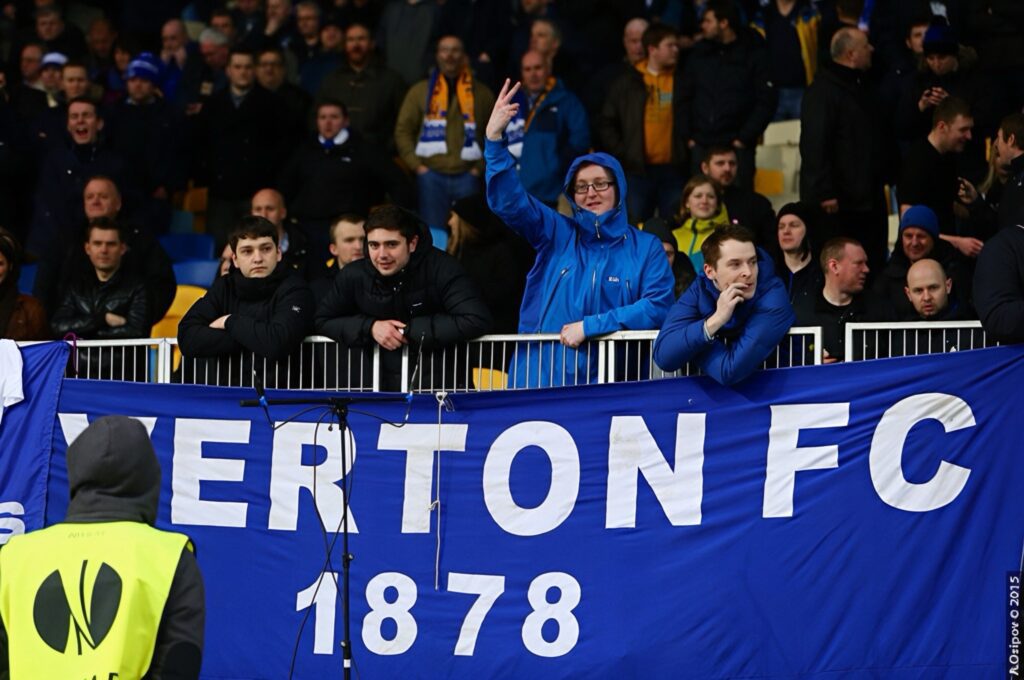
Featured image via Aleksandr Osipov / Wikimedia Commons.