


2025. Undeniably, one of the most divisive and unpredictable years in American politics this century. A year in which convicted felon Donald Trump retook the presidency, four years after losing to Biden, and transformed the state of the United States irreversibly. So, what actually happened in 2025 under Trump’s second administration?
The Return of President Trump
Trump’s second presidency officially began on the 20th January, after becoming the second president to be elected twice to the role non-consecutively. However, it did not come without controversy as only ten days prior, Trump was sentenced to an unconditional discharge after his earlier conviction in May 2024 for 34 counts of falsifying business records to conceal payments made to the pornographic film actress Stormy Daniels to force her in to silence about their previous sexual relations ahead of the 2016 elections. Thus, Trump also became the first convicted felon to fulfil the mantle of US President.
Additionally, Trump’s return was preceded by Joe Biden issuing last-minute preemptive pardons to Dr. Anthony Fauci, General Mark Milley, and the House January 6 Committee staff to shield them from potential “politically motivated prosecution” under the new administration.
The Transition to a Trump Administration
Within hours of his inauguration on January 20, 2025, Trump bypassed congressional deliberation to govern via unilateral executive action. He immediately signed several high-impact executive orders, most notably Executive Order 14158, which established the Department of Government Efficiency (DOGE) to overhaul federal staffing, contracts, and technology. He also moved to fulfil campaign promises on illegal immigration by attempting to end birth right citizenship and close the Mexican border; however, both initiatives were stalled by persistent judicial and legislative challenges throughout the year.
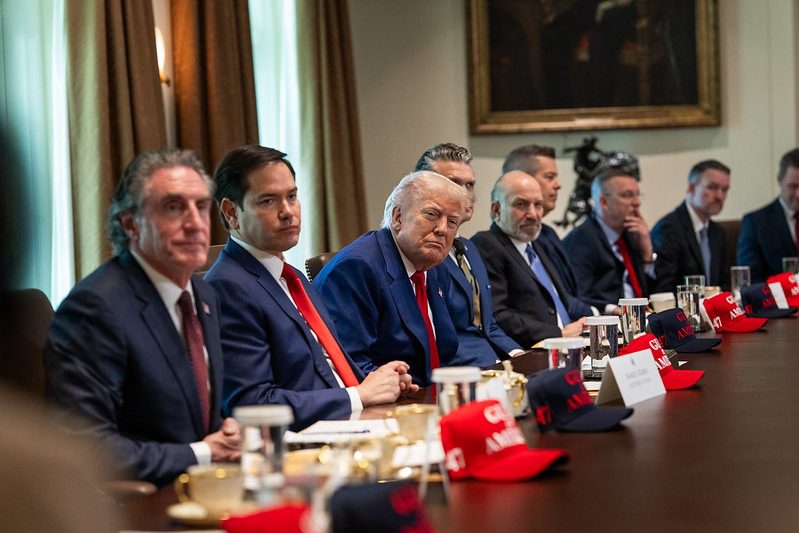
Image: President Trump holds a cabinet meeting – The White House / Molly Riley
The early months of 2025 were further defined by a cabinet selection process that prioritised ideological loyalty over governing experience. Although the Senate began confirmations in late January, the results highlighted a deeply divided government. Nominees were pushed through by the narrowest of margins, exemplified by Kash Patel’s 51-49 confirmation as FBI Director and Pam Bondi’s 52-46 vote for Attorney General, foreshadowing a year of institutional friction and fractured governance.
The Rise and Fall of Elon Musk’s Political Career
A central drama of 2025 was the rapid deterioration of the relationship between Trump and tech oligarch Elon Musk. During the January 20th inauguration, Musk ignited international controversy with a hand gesture that critics widely interpreted as a Nazi salute. Although Musk dismissed the gesture as a “dirty trick” and a misunderstood expression of enthusiasm, the damage to his public image was immediate. This incident marked the beginning of Musk’s decline as a political emblem for the new administration.
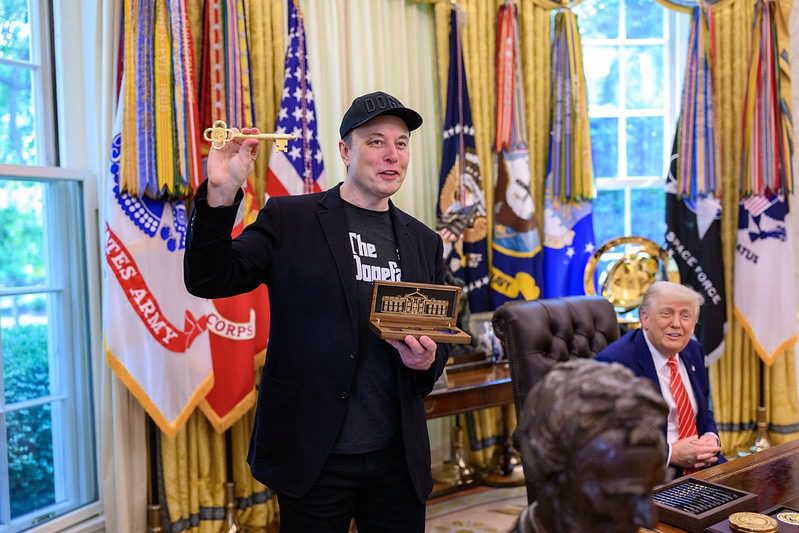
Image: President Donald Trump participates in a press conference with Former DOGE adviser Elon Musk
Over the following months, friction between Musk and the White House intensified. On May 28, 2025, Musk abruptly announced his departure from his government role with DOGE, citing fundamental disagreements over fiscal policy and Trump’s signature “One Big Beautiful Bill.” This public rupture brought a swift end to one of the most unconventional partnerships in American history. While some saw it as proof that Musk’s influence was overstated, others speculated that Trump orchestrated the split to reassert his own authority and silence rumors that he was being controlled by Musk’s profit-driven agenda.
Trump’s Major Victories: The Big Beautiful Bill and War on Immigration
Trump’s defining legislative achievement arrived on Independence Day with the signing of H.R. 1, officially Public Law 119-21 but famously dubbed the “One Big Beautiful Bill Act” (OBBB). This sweeping legislation restructured federal tax policy, shifted spending priorities, and raised the debt limit to secure the administration’s domestic core. However, the victory was polarising; a June 2025 poll revealed 55% public opposition, fuelled by projections that 10.9 million Americans would lose health insurance due to deep Medicaid cuts. Even Elon Musk broke ranks to label the bill a “disgusting abomination,” arguing that its heavy spending betrayed Trump’s promise to reduce state intervention.
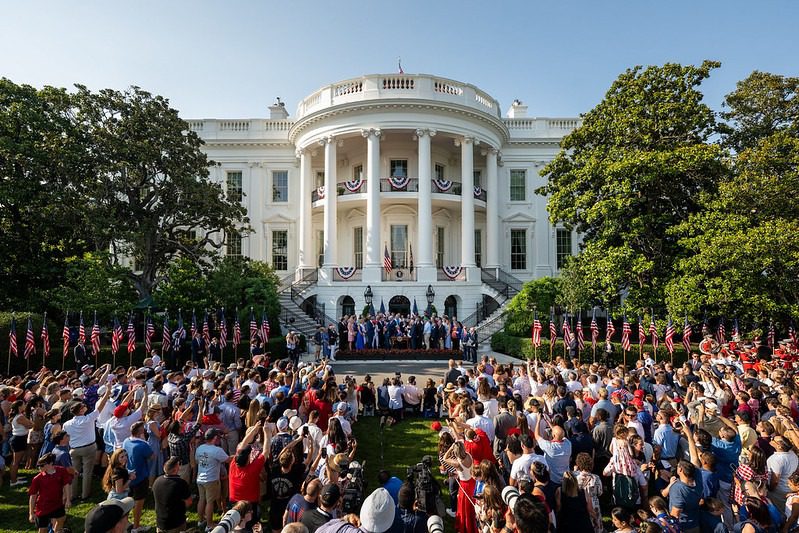
Image: President Trump signs the One Big Beautiful Bill Act on the South Lawn of the White House – The White House / Molly Riley
Parallel to this fiscal overhaul, the administration intensified its crackdown on immigration. Throughout 2025, Immigration and Customs Enforcement (ICE) ramped up operations to unprecedented levels, with year-end data showing detention numbers exceeding 68,000 individuals and hundreds of thousands of removals. While the administration touted these figures as a fulfilment of campaign promises, critics condemned the surge, characterising ICE as an oppressive tool designed to forcibly remove those who did not fit the administration’s narrow vision of American identity.
The Budget Impasse
Institutional dysfunction came to a head in the autumn. On 1 October, failure to pass FY2026 legislation triggered a partial federal government shutdown. This failure is innately damning towards Trump’s administration, for FY2026 is essentially a budget for the next year, that decides whether or not Trump is able to go ahead with his agenda for his next year of presidency. After weeks of failed negotiations and rejected stopgap measures, the shutdown eventually ended on 12 November 2025, following the passage
and signing of a temporary funding agreement. Whether congressional co-operation will last is yet to be seen, thus marking 2026 as crucial for restoring bi-partisan relations.
The Story of the Year
In 2025, the long-promised disclosure of the Jeffrey Epstein files revealed a harrowing intersection of elitist corruption and a systemic corrosion of accountability. The documents prove Epstein utilised poverty and desperation to exploit children, luring vulnerable girls with false promises of educational funding in a “horrific caricature of social mobility.” Far from being a “lone predator,” Epstein operated within a system that required the confidence that accountability would never arrive. This corruption is past partisan lines, infiltrating all of American politics; to reduce the case to the pathology of one dead man is to offer “closure to power, not justice to victims.”
The most disturbing revelation is the “sheer mundanity” of the material evidence. Inventories of sleeping aids, anti-fungals, and children’s cough syrup reveal a functional medical supplies closet, “curated to manage the physical consequences of exploitation.” This existed openly, protected not by secrecy, but by an assumption of impunity. Furthermore, the role of ordinary commercial infrastructure like Amazon in facilitating this abuse raises deeply uncomfortable questions about the “banality of corporatism,” where ethics are sacrificed for a price.
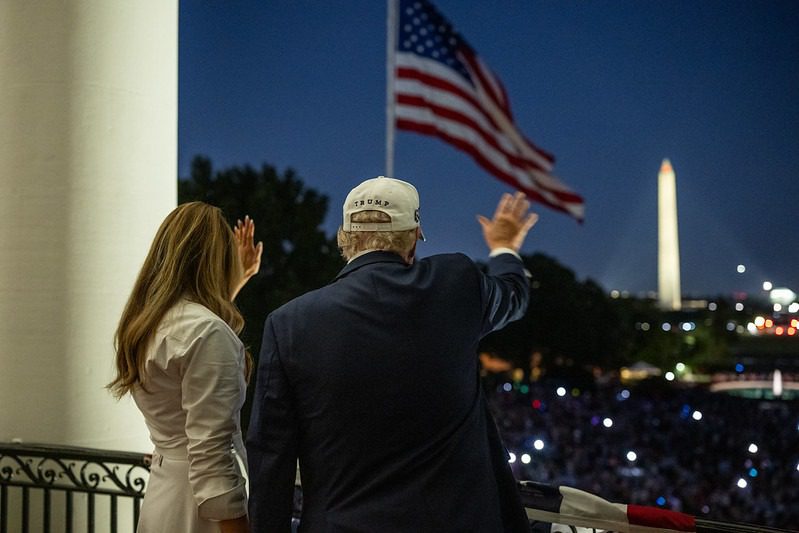
Image: President Donald Trump and First Lady Melanie Trump view a 4th of July fireworks display over the National Mall from the Blue Room Balcony – The White House / Daniel Torok
The DOJ’s decision to delay and release censored files suggests an attempt to manage the truth as a liability, potentially shielding figures like Trump and Clinton from inevitable accountability. “Transparency deferred is transparency denied,” reinforcing the reality that justice remains conditional. The files also hint at transnational implications; references to “MOSCOW GIRLS” and photo sets from St. Petersburg suggest intersections with foreign interests, including Vladimir Putin, which should be treated as a matter of national security rather than a failing of democracy.
The files also expose the “ideological contours” of Epstein’s worldview, including explicit racial bias and a stated “distaste for ‘dark girls,'” underscores how victims were commodified according to prejudice. As the year draws to a close, the promised clarity has been replaced by partial truths administered to preserve institutional credibility. 2025 has revealed that American politics is “corrupted so innately” that any true change feels meaningless, as democratic justice has arguably been destroyed.
In summary, 2025 has been a year of systemic erosion, where the mechanisms of the state were recalibrated to serve personal loyalty and elite protection over public accountability. Between the dismantling of the social safety net via the “One Big Beautiful Bill” and the strategic suppression of the full Epstein files, the administration has replaced transparent democracy with a “banality of corporatism.” America enters 2026 not as a nation restored, but as one waiting to see if its foundational justice can survive another year of intentional corrosion.
Featured Image via The White House / Daniel Torok