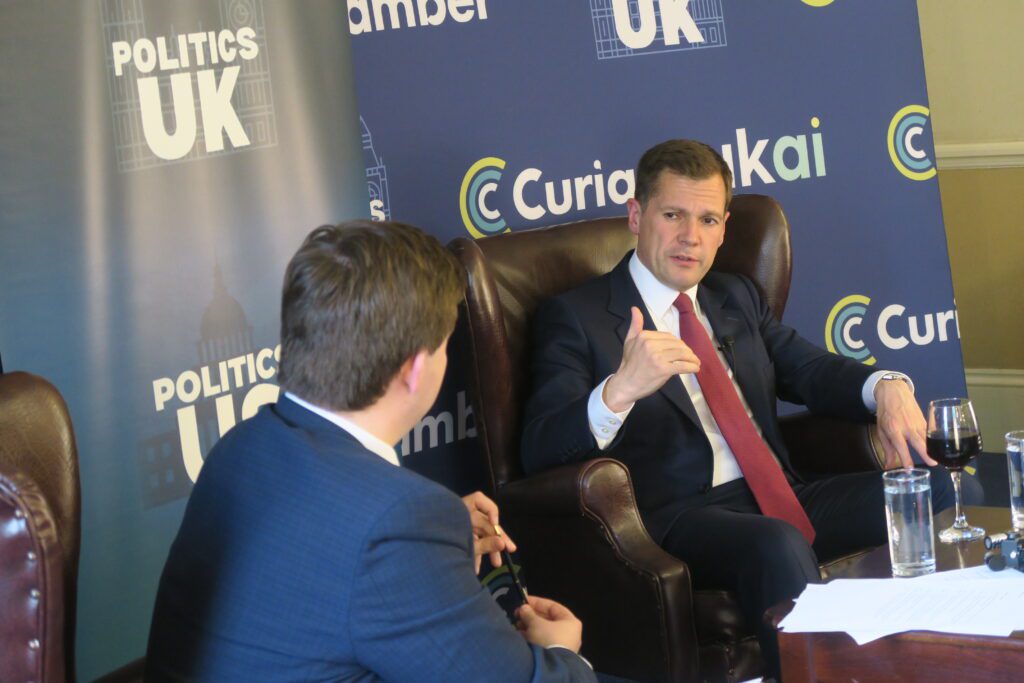

In a recent “In Conversation” event hosted by Politics UK, high-profile Reform UK figures Robert Jenrick MP and London Mayoral candidate Laila Cunningham outlined the party’s platform, structural vision, and economic strategy.
Addressing an audience of journalists and political observers, Jenrick, the Reform UK Treasury Spokesperson, used the platform to detail a sweeping policy agenda centred on tackling productivity stagnation, restructuring the welfare system and securing border sovereignty.
Economic Philosophy: Moving Beyond “Belgravia and Benefit Street”
Jenrick outlined a foundational economic philosophy designed to appeal directly to middle and lower-income workers, positioning Reform UK as the explicit champion of the 80% of the population that constitutes the active, hard-working core of the country. He sought to draw a sharp rhetorical contrast between the two traditional major parties, characterising the current Westminster landscape as an ideological failure that leaves ordinary workers entirely unrepresented.
In his assessment, British politics has devolved into an ecosystem that caters only to extreme opposite ends of the socioeconomic spectrum. Jenrick defined the Labour Party as the political vehicle for “Benefit Street,” focused heavily on welfare expansion, while accusing the Conservative Party of protecting the corporate and aristocratic interests of “Belgravia,” an affluent district in central London.
“Not Benefit Street, not Belgravia,” Jenrick stated, asserting that the vast majority of citizens who go out and work hard everyday currently lack a government that is on their side.
To rectify this imbalance, he argued that Reform UK’s economic strategy is built on structural equity, ensuring that those who contribute productively are treated fairly and respectfully, rather than being squeezed by taxation to fund state inefficiencies or elite privileges.
Family Policy, Welfare Overhaul, and the Two-Child Benefit Cap
On domestic policy, Jenrick addressed the party’s stance on the controversial two-child benefit cap, clarifying a shift in approach dictated by the UK’s current financial reality. While Reform UK had initially backed removing or adjusting the cap for households where parents are in work, Jenrick explained that economic constraints mean the party does not support removing the cap now. He stated definitively that the country simply cannot afford to lift the cap, framing its retention as a necessary act of fiscal discipline.
Despite acknowledging these state budget limits, Jenrick levied heavy criticism against his former party’s record, claiming that the Conservatives did very little for the family during their fourteen years in overment, failing to deliver on a core tenet of Tory ideology. He argued that a genuine pro-family policy must adapt to economic limitations rather than relying on state handouts, which risk worsening the welfare deficit.
Instead of direct welfare expansion, Reform intends to support working parents by lowering baseline living costs through supply-side interventions. Jenrick argued that the most effective way to assist families without straining public finances is to bring domestic energy bills down, implement targeted tax reductions for working people, and introduce measures to lower rental costs across the housing market – all of which could be achieved by getting public spending under control and cutting waste. This approach is designed to position Reform UK as the party of workers and productivity rather than state dependency.
Party Dynamics and Farage’s Leadership
The event offered an inside look into how Reform UK operates internally compared to the traditional Westminster structures. Jenrick praised the party leader Nigel Farage as a decisive figure who actually listens to both his colleagues and the public. While acknowledging that he and Farage do not agree on every single policy point, Jenrick explained that internal discipline relies on a strict standard where disagreements are handled behind closed doors rather than played out in public.
Jenrick contrasted Farage’s long-term consistency on domestic issues with Prime Minister Keir Starmer, whom he criticised for being consistent only on international law which Jenrick argued he used to give away the Chagos Islands and betray British veterans. He emphasised that a stable government requires absolute certainty from leadership, stating that with Farage, voters know exactly where he stands/
Furthermore, Jenrick claimed that whereas the Conservative Cabinet had devolved into a mere rubber-stamping body, the Reform UK leadership operates as a genuine decision-making body where real debates take place. He noted that while the Conservatives remained consistently divided over the European Convention on Human Rights (ECHR) and Net Zero targets, Reform UK’s total alignment on these issues gives the public genuine hope that the party can form a stable, cohesive government. Jenrick also indicated that the party’s internal composition is stabilising, stating he does not expect or seek further Tory defections following the party’s internal May 7th deadline.
The “Makerfield Model” and the Personal Impact of Defection
Looking ahead to upcoming electoral tests, Jenrick focused heavily on the Makerfield by-election, expressing confidence that Reform UK would secure the seat. He highlighted Reform candidate Robert Kenyon, a local veteran and plumber deeply embedded in his community, as the exact archetype for the party’s broader electoral ambitions. Jenrick stated that the party’s immediate mission is to replicate this model nationwide, finding 650 candidates who share Kenyon’s real-world background and community connections.
His message to the Makerfield electorate was to avoid being taken for granted or treated as mere political stepping stone for Greater Manchester Mayor Andy Burnham to return to Parliament. Jenrick took a direct swipe at Burnham, referring to him as the King of the North who spends a significant amount of time trying to flee to the South, describing him as a standard Westminster insider rather than a true regional outsider.
Reflecting on his own political shift, Jenrick admitted that leaving a party he had been part of for nearly 30 years was a tough decision that had strained valuable personal friendships, although maintained that he didn’t regret it nor did he miss the social circles as making a difference was more important.
Border Sovereignty, Migration Control, and Welfare Reform
Jenrick linked his policy positions on national sovereignty and domestic economic revival, stating that border control is the mandatory starting point for addressing Britain’s current economic model. When asked to identify the single most critical action required to regain control of the UK’s borders, Jenrick’s response was definitive: leave the ECHR and regain absolute parliamentary sovereignty. He described previous Conservative border policies as an exercise in merely managing the symptoms of the crisis rather than solving the core legal hurdles, stating that Britain must be prepared to fully exit foreign treaties to protect its own laws.
This legal reclamation of the border forms the strategic baseline for his broader macroeconomic points regarding population movement and productivity. Jenrick stated that for 25 years, the UK has pursued an unsustainable policy of mass migration, claiming that the influx under Boris Johnson’s administration primarily consisted of low-wage, low-skilled workers who did not contribute to high-value productivity. According to Jenrick, this reliance on cheap imported labour has structurally damaged the UK economy by discouraging businesses from investing in domestic talent and advanced technology. Instead of automating processes or training British citizens, companies have relied on an endless supply of cheap numbers, which has directly caused poor national productivity rates.
To reverese this long-term decline, Jenrick stated that migration cuts must be coupled with a radical overhaul of the welfare system to address the country’s massive crisis of economic inactivity, which is currently approaching 10 million people. This structural strategy targets both ends of the demographic spectrum simultaneously, looking to re-engage the one million young people classified as NEETs (Not Education, Employment, or Training) as well as older individuals who have chosen to retire early.
By implementing robust welfare incentives and drastically reducing the availability of foreign labour, a Reform government aims to compel businesses to reinvest in British skills and adopt efficiency-boosting technologies like robotics to drive catch-up growth. Crucially, Jenrick noted that the party also intends to prevent periods of net emigration, ensuring that sustained periods where more productive citizens leave the country than enter are brought to an end.
Jenrick tied this dual policy focus directly to cross-party governance, stating that both Boris Johnson and Keir Starmer wasted massive parliamentary majorities, and he urged voters to cast aside alongside long-standing party loyalties. When asked to evaluate which potential Labour figure, Andy Burnham, Angela Rayner, or Wes Streeting, would be best for the country, Jenrick argued that it would make no difference as they all represent a failed establishment. He concluded by asserting that the mainstream “uniparty” has comprehensively failed, and that Reform UK offers an exciting opportunity to forge something entirely new over a rigorous five-year plan of fiscal discipline, immigration reduction and deregulation.
Laila Cunningham on Polarisation and the Reality of London Politics
Laila Cunningham, Reform UK’s candidate for the London Mayoral election, shifted the focus to the specific structural challenges of campaigning in the capital. She described London as an entirely different political “beast” where public perception of the party remains highly polarised, driven largely by social media echo chambers and partisan rhetoric.
Cunningham shared an encounter from the campaign trail on a local basketball court, where a young resident, upon discovering her party affiliation, reacted with immediate shock, stating that they believed Reform UK intended to deport their mother.
“People get stuck in a tunnel vision that Reform is completly anti-immigrant, that they are going to deport everyone, and that they are racist,” Cunningham observed, positioning herself as the ideal candidate to actively dismantle that narrative across the city.
As the daughter of Egyptian immigrants who arrived in the UK during the 1960s, Cunningham rejected the premise that an ethnic minority background requires an alignment with high immigration volumes. She stated that her parents came to the UK specifically for a “British country, British values and British way of life”, noting that had they desired a quasi-Egyptian system, they would have remained in Egypt.
Cunningham stated there is zero logical contradiction between being the daughter of immigrants and advocating for strictly controlled, legal immigration. Concluding her remarks, she delivered a bleak assessment of the capital’s trajectory, stating that despite London fundamentally being the best city in the world, it has ceased to be place of opportunity for ordinary residents, transforming instead into a difficult and unpredictable environment under the current political leadership