
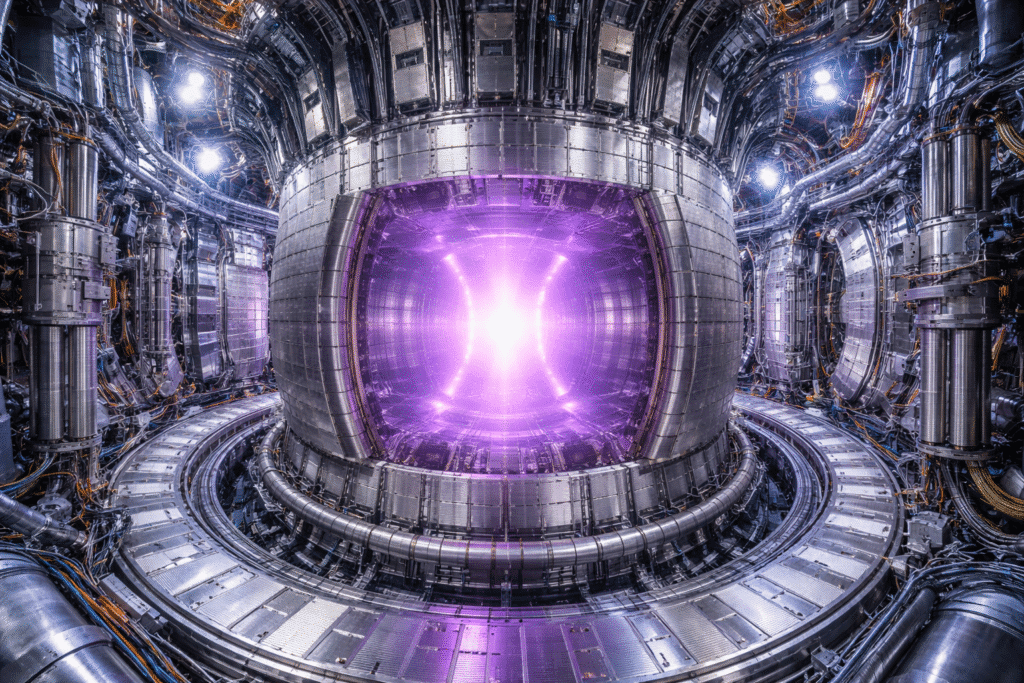
The UK Government has unveiled a new national strategy aimed at making the UK the global leader in commercial fusion energy, setting out a clear pathway for developing a domestic fusion industry capable of delivering long term energy security, skilled jobs and economic growth.
The Fusion Strategy, published today by the Department for Energy Security and Net Zero alongside the UK Atomic Energy Authority (UKAEA), outlines how the Government plans to move fusion from research laboratories to commercial deployment.
Ministers say the strategy will support more than 10,000 jobs by 2030, unlock major private investment and place Britain at the forefront of a global race to harness fusion power – a technology capable of generating vast quantities of clean energy by replicating the processes that power the sun.
The announcement comes amid growing concerns about global energy security and volatility in fossil fuel markets, which ministers argue reinforces the need for domestically generated clean power.
The Government says Britain is now the first country to establish a clear pathway to commercial fusion, creating the policy, investment and regulatory frameworks required to bring the technology to market.
A new phase for Britain’s fusion sector
The strategy builds on £2.5 billion in public investment in fusion research and development confirmed at the most recent Spending Review. It also includes targeted funding to accelerate industrial deployment, including infrastructure, advanced computing and workforce development.
A central element of the fusion plan is the development of the STEP prototype fusion power plant at West Burton in Nottinghamshire, a former coal power station site that will be repurposed for next generation clean energy production.
The Government has announced a £200 million contract for a construction partner to help deliver the plant, with construction expected to begin from 2030 and completion targeted by 2040.
Ministers say the project symbolises the UK’s wider energy transition, with regions historically associated with coal power becoming hubs for the next generation of clean energy technologies.
New market framework for fusion power
The strategy also introduces what the Government describes as a world first market framework for fusion electricity, designed to provide confidence for investors while protecting consumers.
Under the framework, government will develop regulatory and insurance structures tailored specifically to fusion technologies, alongside streamlined planning processes and new safety guidelines.
Officials believe the move will de risk private sector investment and accelerate the commercialisation of fusion technologies.
The global fusion market is expected to be worth up to £12 trillion in the second half of the century, with countries including the United States, China and Japan all investing heavily in research and industrial capacity.
Investment in AI and advanced research
Alongside infrastructure investment, the Government has confirmed funding for a fusion dedicated artificial intelligence supercomputer designed to accelerate research and engineering breakthroughs.
The Sunrise AI supercomputer, developed through a collaboration between UKAEA and the University of Cambridge, will receive £45 million in funding and is expected to become the most powerful computing system in the world specifically designed for fusion modelling.
The system will help scientists simulate plasma behaviour, optimise reactor design and accelerate the development of commercial fusion reactors.
Skills, investment and industry growth
The strategy also sets out plans to expand Britain’s fusion workforce through a £50 million skills and innovation programme aimed at training more than 2,000 people in fusion related disciplines.
This will include apprenticeships, specialist training programmes and the development of regional innovation clusters linked to major fusion research centres.
The Government is also preparing a national fusion investment prospectus intended to attract international investors and supply chain partners.
Alongside this, UKAEA and the global energy technology company Eni have announced plans to establish a joint company focused on advancing fusion technologies, with further details expected in May.
Fusion innovation beyond the energy sector
Research driven by fusion development is already generating wider technological innovation across the UK economy.
UKAEA recently confirmed the creation of three spin out companies, with several more expected in the near future, applying fusion technologies across sectors including medical imaging, advanced robotics, defence technologies and AI assisted engineering.
Officials say these spin offs demonstrate the broader economic value of fusion research beyond electricity generation.
Ministers: Britain can lead the fusion era
Energy Secretary, Ed Miliband said the strategy positions Britain to lead the global transition towards clean and abundant energy.
He said:
“From Nottinghamshire to Cumbria, and from the Oxford Cambridge corridor to South Yorkshire, Britain has long been at the forefront of fusion energy.
“With our Fusion Strategy, we are going further – backing industry, supporting more than 10,000 jobs and paving the way for the ultimate long term energy security solution: clean, virtually limitless energy powered by British ingenuity and determination.”
Science Minister, Lord Vallance said the strategy would strengthen Britain’s position as a global centre for scientific and engineering innovation.
He said:
“We can be proud that Britain will lead the way on research, innovation and skills for a future of limitless fusion energy.
“By backing our fusion industry we are not only securing our future energy independence but also creating the skilled clean energy jobs of the future for British people.”

Industry welcomes government strategy
Industry leaders have broadly welcomed the strategy, saying it provides clarity and investment certainty for the emerging fusion sector.
Dr Tim Bestwick, Group CEO of the UK Atomic Energy Authority, said the organisation supports the Government’s ambition to position Britain as a global hub for commercial fusion technology.
He said UKAEA’s programmes are already progressing key technologies needed for commercial deployment.
Tristram Denton, UK Director of the Fusion Industry Association, said the strategy strengthens Britain’s position within what he described as a “generational industrial opportunity”.
Executives from leading UK fusion companies, including Tokamak Energy and First Light Fusion, also welcomed the announcement, highlighting the UK’s existing research strengths and the importance of government backing for scaling commercial deployment.
Global collaboration on fusion development
The strategy also highlights growing international collaboration on fusion research.
Fusion energy was recently included in the UK US Tech Prosperity Deal, which aims to accelerate joint research between British and American institutions.
A UK US Global Fusion Policy Summit is expected to take place later this year to further develop international co-operation on regulation, investment and technological development.
With the launch of the strategy, ministers say Britain now has the policy framework and industrial foundations required to lead the global race to commercial fusion energy.