
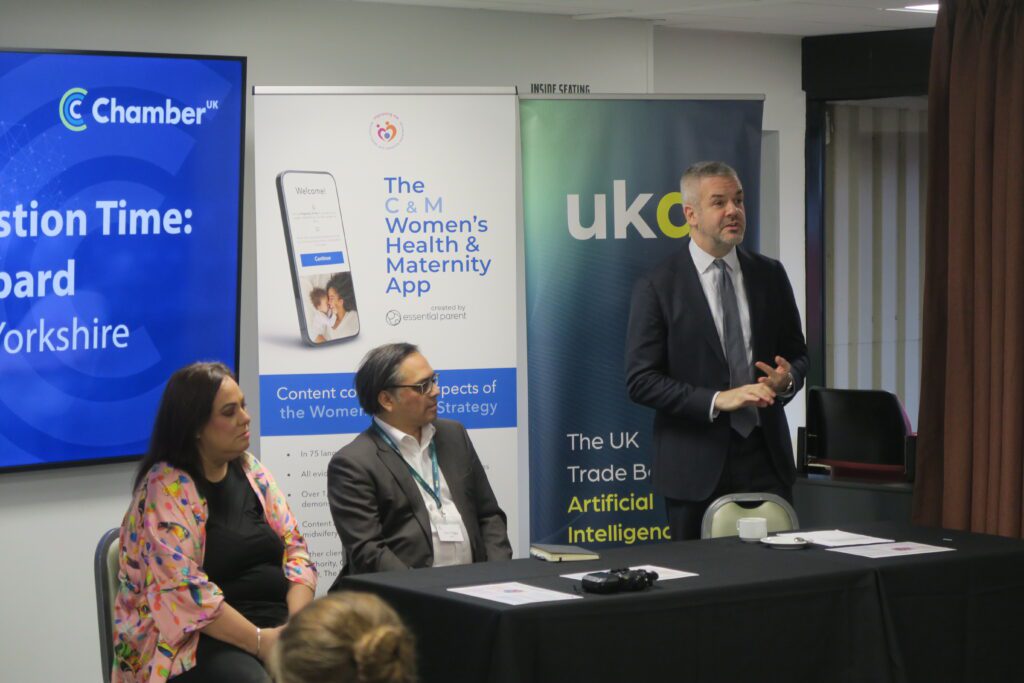
Mayor of South Yorkshire, Oliver Coppard addresses the Accelerating NHS Innovation: North Of England Summit in Barnsley and joined a panel with former Shadow Minister for Social Care and Mental Health, Paula Sherriff and CEO of UKAI, Tim Flagg
Health innovation could add £246 billion annually to UK productivity – almost 10% of GDP – yet proven technologies still take years to reach NHS frontlines, often benefiting those with the most resources first.
At an NHS innovation summit in Barnsley in February, South Yorkshire Mayor Oliver Coppard made the case that devolution offers the practical mechanism to accelerate adoption, narrow inequalities, and turn health improvement into regional economic growth.
The Accelerating NHS Innovation Summit, organised by not-for-profit independent policy institute Curia, brought together NHS Integrated Care System (ICS) leaders, innovators, academics, policymakers, and councillors to examine how the North of England can translate innovation ambitions into everyday care.
Devolution and place-based leadership
The Mayor framed devolution not as bureaucratic restructuring but as bringing decision-making closer to the communities that experience health challenges most acutely.
Drawing on his direct engagement with constituents – whether at Tesco, the pub, football matches or Parkrun – he described mayors as uniquely positioned to notice what is changing, understand why it is happening and respond with policies tailored to local reality.
“Devolution gives us the ability to notice what’s changing, understand why it’s happening, and respond quickly with policies that match the reality on the ground,” Coppard said.
He acknowledged that national policymakers care deeply about health outcomes but argued they simply do not have the time or structural capacity to look as closely as regional leaders can.
Health as economic policy
The Mayor positioned health improvement as inseparable from economic success, pointing to Health Innovation Network research showing healthier populations could add £246 billion annually to UK productivity, which is almost 10% of GDP.
“Improving health isn’t just morally right. It’s fundamental to economic success,” Coppard told the summit.
South Yorkshire has embedded that principle into its local growth plan, with initiatives like the Olympic Legacy Park demonstrating how prevention, research, and economic regeneration can reinforce one another.
The Mayoral Combined Authority is deploying devolved powers over transport, skills, regeneration, and innovation to align health outcomes with regional prosperity.
The reality of health inequality
For South Yorkshire, that proximity reveals inequalities that national systems often miss. Women in Barnsley have the lowest life expectancy anywhere in the country. Across the region, a 20-year healthy life expectancy gap persists – meaning people in some communities spend two decades longer in poor health than those in others.
Coppard argued these divides harm individuals, families, and communities while holding back economic growth. He argued that innovation must be used deliberately to close these divides rather than reinforce them.
Without that focus, he warned, new technologies risk reaching those already closest to opportunity first – leaving the communities facing the greatest health challenges further behind.
“If we are serious about leading the way, then we need to see innovation helping to narrow inequalities rather than widening them,” Coppard said.
Building an innovation ecosystem in South Yorkshire
Coppard outlines how South Yorkshire has assembled the infrastructure to translate ambition into practice. The Olympic Legacy Park in Sheffield serves as a focal point, bringing together the Mayoral Combined Authority, Sheffield City Council, the NHS, universities, and industry to create a space where prevention, sport, wellbeing research, and economic regeneration reinforce one another.
Within that ecosystem sits the Advanced Wellbeing Research Centre, where patients, clinicians, and researchers collaborate to test new health technologies.
Soon, the sites will host the National Centre for Child Health Technology, a £22 million partnership between the NHS, central government, and Mayoral Combined Authority, which is contributing £6 million to develop robotics, virtual reality, and tools supporting children’s long-term conditions and mental health.

When innovation stalls
Despite those assets, Coppard was candid about structural barriers that devolution alone cannot overcome. Proven innovations, he noted, often take years to move from pilot to frontline adoption, with early beneficiaries disproportionately those already closest to resources and opportunity. He cited new obesity medicines as an example, observing that the vast majority of early prescriptions have been private.
“Too many proven innovations take years to reach the frontline. Too often, the first beneficiaries are those with the most resources,” Coppard said.
He identified three areas requiring national action.
First, the imbalance in research funding must be addressed – it cannot be right, he argued, that a single London institution receives the same public research funding as the entire North of England. Coppard has written to ministers proposing an Institute for Preventive Health Research for the North, recognising that regions with significant health challenges also possess world-class research assets.
Second, the NHS itself must accelerate adoption. Procurement processes need to become more agile, evaluate faster, and the pathway from pilot to scale clearer.
Crucially, workforce and digital infrastructure require sustained investment, as innovation only works when clinicians have the time and tools to adopt it.
Third, innovation must be woven into economic strategy in ways that narrow rather than widen inequalities, with programmes co-designed alongside communities and tested in real-world settings.
Where mayors can act
During the fireside discussion led by former Shadow Minister and member of Curia’s Health, Care, and Life Sciences Research Group Advisory Board, Paula Sherriff, Coppard was asked how mayors can influence health when the NHS remains nationally governed.
His answer focused squarely on prevention – the domain where mayoral powers over transport, employment, skills, and economic policy create conditions for innovation to thrive.
He pointed to a striking statistic: one in five bus journeys in South Yorkshire relates to healthcare, whether nurses, doctors, or care workers travelling to work or patients attending appointments. A functioning healthcare system, he argued, cannot exist without a functioning transport system.
South Yorkshire is bringing buses back under public control, creating an opportunity to align transport planning with public health and prevention strategies in ways that fragmented private operators and national oversight cannot achieve.
“Prevention doesn’t happen through the NHS in the way it could or should, because the NHS is always under pressure to deal with immediate acute problems,” Coppard observed.
Mayors, he suggested, face urgent pressures but not identical ones, enabling them to convene actors across skills, transport, public health, innovation, education, and universities in ways Whitehall structurally cannot.
Leading through outcomes
Asked what would demonstrate that Yorkshire is genuinely leading on NHS innovation in a year’s time, Coppard focused on outcomes rather than activity.
Success would mean innovation reaching people who need it most, benefits not confined to those already closest to opportunity, and services designed around how people live rather than how institutions are organised.
The summit’s broader agenda – focusing on women’s health and obesity pathways through Curia’s sprint methodology – reflected recognition that innovation depends not only on technology and funding but on commissioning structures, workforce support, data infrastructure, and political will.
Coppard’s contribution underscored that for regions like South Yorkshire, devolution provides the mandate and tools to align those elements more effectively than national systems acting alone.