
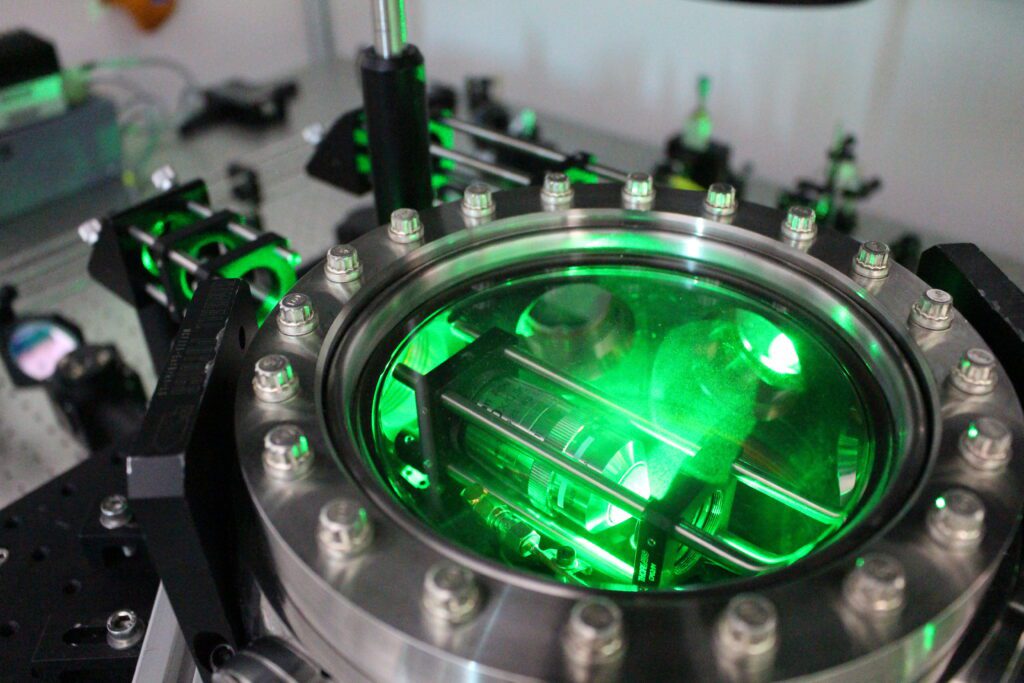
The UK could unlock tens of billions of pounds in economic value by strengthening its leadership in photonics – the science and technology of light – according to new advice to the Prime Minister from the Council for Science and Technology.
In a report titled Photonics: Capturing the Opportunities for Growth and Global Leadership, the Council argues that photonics is a foundational technology underpinning some of the most transformative sectors of the modern economy, including artificial intelligence (AI), quantum technologies, advanced manufacturing, telecommunications and healthcare.
Despite the UK’s strong research base and industrial capability, the advisers warn that the country risks losing momentum to global competitors if it fails to co-ordinate policy, skills development and investment over the next few years.
A critical technology hidden in plain sight
Photonics refers to technologies that generate, manipulate and detect light. These systems are essential components in modern communications networks, high-precision sensors, biomedical imaging systems and advanced manufacturing equipment.
In many ways, the sector already plays a central role in the UK economy. The UK photonics industry generated £18.5 billion in turnover in 2024, contributing around £8.6 billion in gross value added and employing tens of thousands of highly skilled workers.
Moreover, the influence of photonics stretches far beyond the sector itself. Government advisers estimate that more than 60% of the UK economy could depend directly on photonics by 2035, as technologies such as AI infrastructure, autonomous vehicles and advanced medical diagnostics rely increasingly on optical systems.
As the report states, photonics “underpins 13% of global innovation output” and is already embedded across industries from defence and clean energy to life sciences and telecommunications.
A race for global leadership
The Council for Science and Technology emphasises that the UK’s opportunity remains significant but time-limited. Several major economies – including the United States, China, Taiwan and Singapore – have already identified photonics as a strategic technology and are investing heavily in national capabilities.
If the UK can act quickly, however, advisers believe the sector could grow to £50 billion in value by 2035, while supporting up to 150,000 additional jobs across the country.
Such growth would place photonics among the UK’s most productive and strategically important manufacturing sectors, comparable in economic scale to aerospace or automotive industries.

Building on regional strengths
The UK already hosts several globally recognised photonics clusters centred around leading universities and innovation ecosystems.
These include hubs linked to the Universities of Southampton, Sheffield, Aston, Strathclyde, Glasgow, Heriot-Watt and Queen’s University Belfast, where research and commercial activity spans optical fibres, quantum photonics, lasers and optoelectronics.
These regional clusters demonstrate that the UK’s strengths in photonics extend well beyond the traditional “golden triangle” of London, Oxford and Cambridge.
However, the report suggests that a lack of co-ordinated national strategy means funding streams, policy initiatives and skills planning are currently fragmented across related technology programmes such as quantum and semiconductors.
Three recommendations for government
To secure the UK’s competitive position, the Council for Science and Technology sets out three core recommendations.
A national photonics roadmap
First, the government should develop a national photonics roadmap by April 2026 to provide a long-term vision for the sector and better co-ordinate public investment, industry collaboration and skills development.
Such a roadmap would bring together existing initiatives across research funding bodies, industry organisations and government departments to ensure that the UK’s scientific strengths translate into commercial impact.
Using public procurement to support UK industry
The second recommendation calls for government procurement programmes to be used more strategically to support domestic photonics companies.
Public sector demand – particularly in areas such as defence, healthcare technology and advanced infrastructure – could help scale UK firms and strengthen domestic supply chains.
Expanding global partnerships and exports
Finally, the report highlights the importance of international collaboration and export growth.
By strengthening global partnerships and ensuring UK companies can access international markets, policymakers could position Britain as a global hub for photonics innovation and manufacturing.
A foundation for the technologies of tomorrow
While photonics may not always attract the same headlines as artificial intelligence or quantum computing, the technology sits quietly at the centre of both.
From the fibre-optic cables that carry internet traffic to the sensors enabling autonomous systems and the imaging technologies transforming healthcare, the future digital and industrial economy is increasingly built on light.
The Council for Science and Technology’s message is clear – if the UK wants to lead in the next generation of advanced technologies, securing government leadership in photonics will be essential.
(Photo: Gavin Morley)