

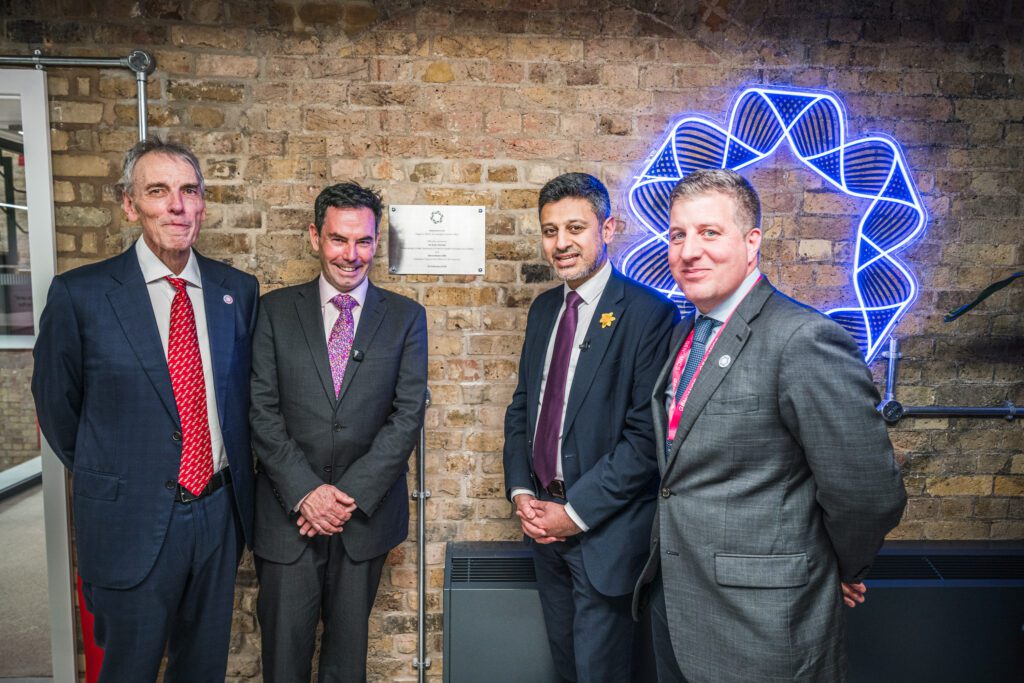
The Minister for Health Innovation, Zubir Ahmed MP officially opens the Genomics flagship. (Photo: (Left to right) Steve Bates, Executive Chair, Office for Life Sciences, Zubir Ahmed MP, Minister for Health Innovation, Department of Health and Social Care, and Professor Sir Peter Donnelly, CEO and Founder, Genomics)
Genomics has opened its new flagship London office in the Knowledge Quarter, King’s Cross – formally inaugurated by Dr Zubir Ahmed – marking a significant moment for the UK’s life sciences and artificial intelligence ecosystem.
The Minister for Health Innovation used the occasion to deliver emphatic praise for the Oxford spin-out, describing it as one of the “jewels in our crown” and placing it at the centre of the government’s ambition to make life sciences both a healthcare and growth priority.
“Companies like you are the jewels in our crown.”
– Dr Zubir Ahmed MP, Minister for Health Innovation, Department of Health and Social Care
Standing before partners from across pharma, biotech and government, the Minister framed Genomics as a British success story built on world-class science and NHS data assets – and one that the government intends to back.
“You are simply transforming the timelines and what is possible in drug discovery right before our eyes.” – Dr Zubir Ahmed
He pointed to unprecedented public investment – including £650 million for Genomics England, £20 million for UK Biobank and over £350 million for Our Future Health – as evidence that genomics and predictive analytics sit at the heart of the UK’s long-term strategy.
As Executive Chair of the Office for Life Sciences, Steve Bates’ presence shows the strategic importance of companies like Genomics to the UK’s Life Sciences Sector Plan.
With a long track record of championing the sector’s global competitiveness, Bates has argued for several decades that the UK’s strength lies in combining NHS data, academic excellence, and commercial scale-up capability. The opening of Genomics’ flagship office – and the integration of agentic AI into its Mystra platform – reflects exactly the kind of science-led, commercially ambitious growth story the Office for Life Sciences is working to accelerate across the country.
From Oxford spin-out to global scale-up
Founded in 2014 by leading statistical geneticists from the University of Oxford, Genomics was built on a clear mission: to use world-class science to transform drug discovery and help people live longer, healthier lives.
In its early years, the company focused on building infrastructure – creating what it describes as the world’s largest harmonised genotype-phenotype data platform, with some tables containing more than two trillion lines of data. That resource links genetic information from millions of individuals to functional genome data and health records.
As CEO and Founder, Professor Sir Peter Donnelly told guests, the company has since evolved into a fully commercial organisation with 130 staff across London, Oxford, Cambridge, Research Triangle Park, and the Boston area.
“Today represents more than a new office. It marks the next chapter in our commercial growth and our mission to harness the power of genetic insight to transform drug discovery and development.”
– Professor Sir Peter Donnelly, Founder and CEO, Genomics
Genomics has featured on the Sunday Times 100 Tech list for two consecutive years and now works across two major verticals: life sciences and healthcare. In 2025 alone, it worked with 11 partners and identified eight drug targets that have progressed into pharma pipelines.
Mystra: unlocking causality in human biology
At the centre of its commercial strategy is Mystra, the company’s SaaS drug discovery platform, hosted on infrastructure provided by Amazon Web Services.
Launched commercially in October 2025, Mystra allows partners to run advanced genetic analyses either on Genomics’ proprietary datasets or their own internal data. Within months, the platform secured seven paying customers, with further partnerships expected to be announced in the coming weeks.
The rationale is grounded in a widely cited statistic: drugs with human genetic evidence are around twice as likely to succeed in clinical trials.
As Donnelly explained, healthcare data is rich in correlation but limited in causality. There are only two ways to establish causality – interventional clinical trials, or genetics. Trials are costly and complex; genetics offers a scalable route to biological insight.
Mystra was designed to make that insight accessible to pharma R&D teams. The new London launch, however, marks the next stage in that journey.
The agentic AI layer – democratising drug discovery
The headline announcement at the opening was the integration of agentic artificial intelligence into Mystra – a conversational, task-oriented AI layer that sits on top of the platform’s data and analytics infrastructure.
Donnelly described it as “the single most exciting thing I have ever seen” in his scientific career.
“Combining our genomic capabilities with agentic AI on Mystra is a big step towards democratising access to genomic insights across the life sciences ecosystem.”
Previously, a research scientist might have needed to draft a memo to a statistical genetics team and wait for analysis on whether a particular gene was a viable drug target. With the agentic interface, they can now query the system directly.
Scientists can ask:
- Is a specific gene a strong target for a given condition?
- What side effects might arise from targeting it?
- Which patient subgroups are most likely to benefit?
- Are there alternative indications worth exploring?
The implications extend beyond the lab. Development teams, senior executives and even investors can interrogate target-disease relationships and pipeline risk in real time.
In Donnelly’s view, this convergence of large-scale genomic data and AI marks a genuine inflection point for the sector.
At the heart of the Knowledge Quarter
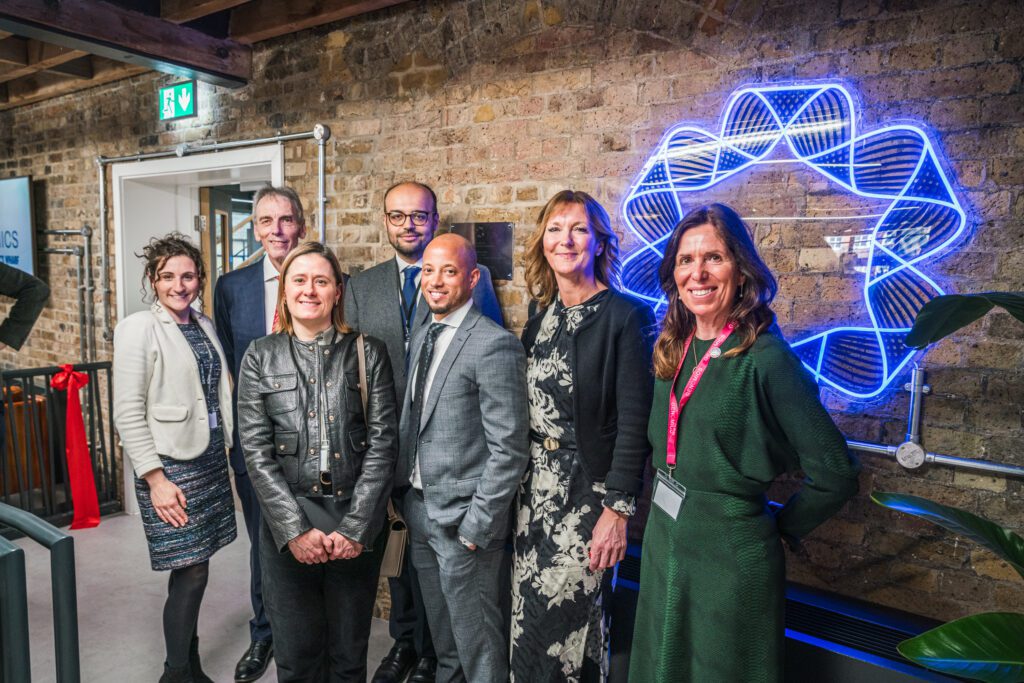
Genomics’ new office places it within London’s Knowledge Quarter – a one-mile innovation district anchored around King’s Cross.
Jodie Eastwood, Chief Executive of the Knowledge Quarter, welcomed the company as the latest member of a community that includes the Francis Crick Institute, the British Museum, Wellcome and University College London.
“Their application of advanced AI to genomic data is exactly the type of forward-thinking science our innovation district is designed to foster.”
– Jodie Eastwood, Chief Executive, Knowledge Quarter
The Knowledge Quarter generates £43.4 billion in gross value added and hosts 25 per cent of London’s life sciences companies. With 2.9 million square feet of wet lab space planned by 2032, it is increasingly positioned as Europe’s leading innovation cluster.
The symbolism was not lost on the Minister, who invoked comparisons with Kendall Square in Boston and argued that the UK has the opportunity to build a life sciences powerhouse of similar scale.
A new partnership model between government and science
Beyond the office opening, the tone of the event signalled a deeper shift – from passive policy support to active partnership between government and high-growth techbio companies.
“We are not simply watching you from the sidelines. We are rolling up our sleeves and getting into deep partnerships with you.”
– Dr Zubir Ahmed MP
The Minister positioned genomics and AI as mission-critical to both patient outcomes and national economic growth. He suggested that the NHS, underpinned by predictive analytics and genetics, could become the “national growth story” of the next 50 years.
The UK intends to compete at the frontier of AI-powered drug discovery – and the Government sees companies like this as central to that ambition.
As the doors opened on All Saints Street in King’s Cross, the company was not simply celebrating a new office. It was staking a claim that Britain can lead the convergence of genetics, AI, and healthcare innovation – and that this moment may, in time, be recognised as the start of a new chapter in life sciences.
To find out more about Genomics, visit: www.genomics.com
Genomics are members of Curia’ Health, Care, and Life Sciences Research Group. To find out more about Curia contact Partnerships Director, Ben McDermott at ben.mcdermott@chamberuk.com
Photos: Genomics