
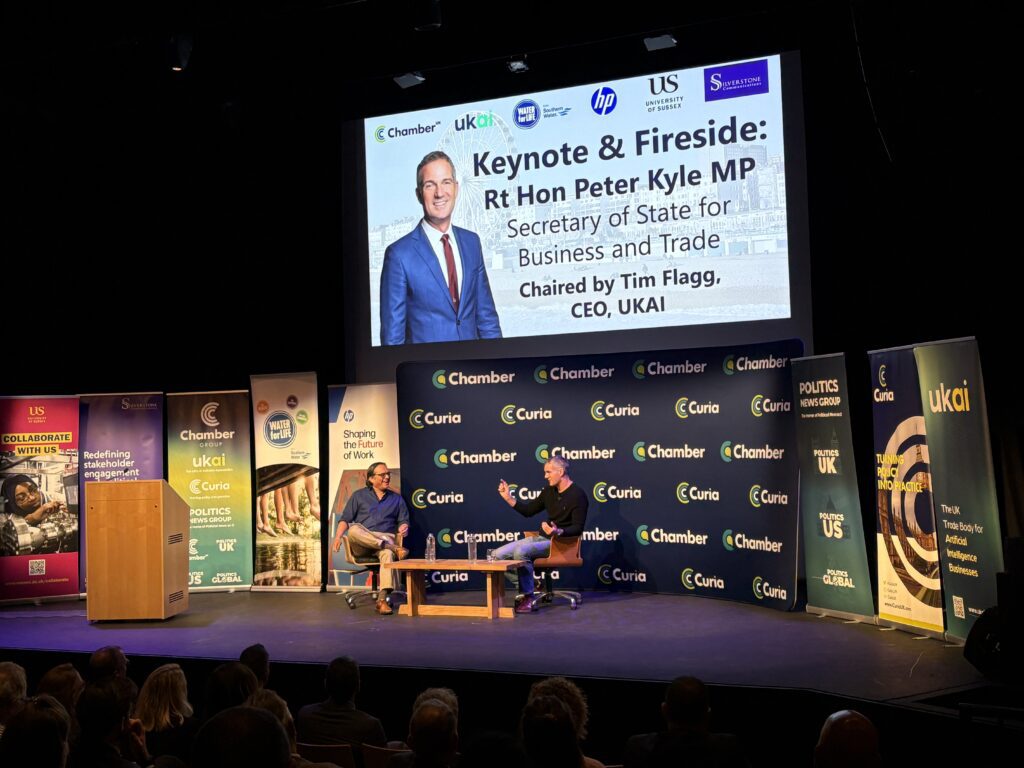
“A growth emergency” is facing the UK, according to Business and Trade Secretary and local MP, Peter Kyle, who spoke at the Get Britain Growing: South East Conference, held in partnership with Chamber UK, Curia, and UKAI. The event united policy experts, leaders, and creators to explore how the South East can drive sustainable, tech-driven growth: both tackling regional challenges and boosting investment and competitiveness.
Discussions centred around how the South East can remain globally competitive while addressing local challenges, such as infrastructure pressures, water resilience, and housing and skills shortages, and attracting sustainable investment.
Interactive sprint workshops later in the day invited delegates to co-design solutions around three themes: healthy homes and communities, clean energy and regional regeneration, and AI for growth.
AI at “Front and Centre” of Growth
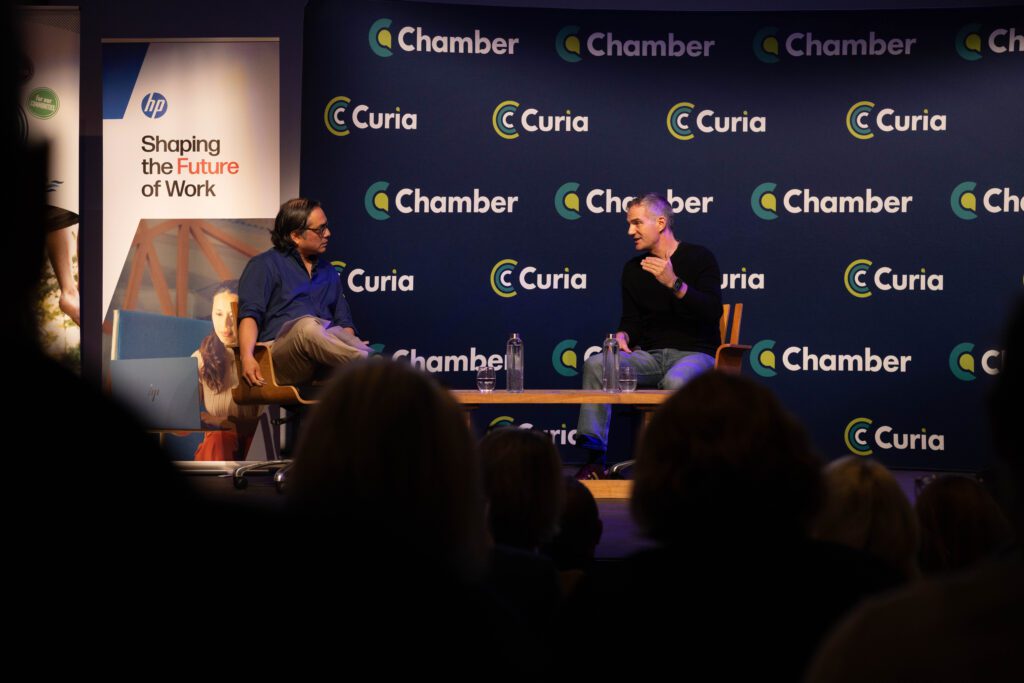
As Secretary of State for Business and Trade, Kyle delivered a wide-ranging address with Tim Flagg, CEO of UKAI, for the conference ‘fireside chat’. In it, he highlighted the Government’s commitment to innovation as the key to overcoming the UK’s “growth emergency”. He insisted that the Government, along with investors and businesses, need a greater “sense of urgency, boldness, and creativity” in the wake of such “incredibly rapid” development in certain areas, such as artificial intelligence (AI).
Kyle outlined plans to connect investment in AI, clean energy, and advanced manufacturing with stronger regional ecosystems, noting that innovation and scale-up support must operate as a single, joined-up system.
He emphasised that the UK cannot avoid the global wave of AI-driven change – and indeed, he celebrated it – but must use the agency of government to shape how it unfolds.
Technology can be a transformative tool for workforce skills, Kyle insisted. He emphasised AI’s transformative potential to democratise learning and close generational divides in digital capability, “If people aged 35 are using AI twice as much as those aged 55, the time it takes to close that gap is a two-hour training session.”
AI, he added, is a “foundational language” and is becoming a “learning tool and teacher” – a democratising agent, and a leveller for those previously held back by traditional education models.
He also announced £233 million in deregulation measures to ease the reporting burden on small businesses, saving firms up to 200 hours per year, with further reforms to follow.
Kyle emphasised that these measures will have a tangible impact on the UK’s most dynamic business communities. “That is 200 hours of work for every business”, he said – time he expects to be reinvested in “building teams, shaping culture, and strengthening customer relationships”. Funding, he claimed, is being redirected towards high-growth sectors, with AI “front and centre” of the strategy.
Investment in Innovation
Alongside deregulation, Kyle explained how the Government is increasing research and development (R&D) investment by 11 per cent, bringing the total commitment over the current Spending Review period to £86 billion. This 11 per cent increase in R&D spending will go hand in hand with new coordination between the Department for Business and Trade and Skills England, and a renewed focus on supporting high-growth sectors such as artificial intelligence.
A Joined-up Innovation Ecosystem
Kyle stressed the need for greater coherence across government, linking innovation policy directly with business scale-up support, “You can’t have a disjoint between where innovation is created and where it scales up. It needs to be much more fluid.”
This joined-up thinking is also being applied regionally. He cited new area-based investment powers for mayors, and he urged universities to play a more active role, as key enablers of growth.
As a graduate of the University of Sussex, where the event was held, he argued that “Universities should play a much more forward-facing leadership role”, highlighting their potential to forge public-private partnerships and spin out new commercial innovations.
Towards an Innovation-led Recovery
The emerging strategy signals a high-tempo push to combine legislative efficiency with technological acceleration, designed to re-energise productivity, boost regional competitiveness and secure Britain’s position as a leader in innovation. Kyle intimated this when he celebrated the South East’s local assets, which “see themselves in relation directly to London. They don’t look inwards” – celebrating the South East’s prized connected, integral partnerships: partnerships that withstand the parameters of metropolitan vs non-metropolitan.
The Secretary of State concluded by calling for stronger regional leadership, praising the emergence of new devolved authorities such as the forthcoming Sussex Mayoralty, and urging universities to play a more active role in local economic strategy: “Brighton and Hove is Brighton and Hove because of its universities. They must be at the heart of our regional leadership and growth story.”
The Get Britain Growing South East Conference was sponsored by HP and Southern Water. The conference was organised in partnership with Silverstone Communications.
To receive a copy of the report, please register for our newsletter: