
The Government has approved a controversial Chinese “super-embassy” in Central London, intended to improve diplomatic relations. Critics fear that this could enable espionage, as nearby communication cables could be infiltrated, and may provide a permanent focal point for anti-Chinese protests outside the building. In addition, the UK plans to set up a forum on cyberattacks to lower tensions between the two states, known as the “Cyber Dialogue,” in hopes of preventing future attacks on British cyber infrastructure.
The Golden Era
Relations between China and Britain have been volatile for over a decade. The relationship first began to degrade under Theresa May’s leadership, ending the so-called “Golden Era” that had emerged following the transfer of Hong Kong’s sovereignty to Chinese control in 1997. After becoming Prime Minister, May reviewed but ultimately approved Chinese involvement in the Hinkley Point C nuclear project in September 2016, with £6 billion invested by the state-owned China General Nuclear (CGN), though this funding eventually ended in May 2025.
Constructive engagement continued under May through formal mechanisms such as the UK–China Economic & Financial Dialogue, which last met in 2019. During this period, cooperation focused primarily on trade, finance, and infrastructure, with relatively limited public confrontation over security or human rights.
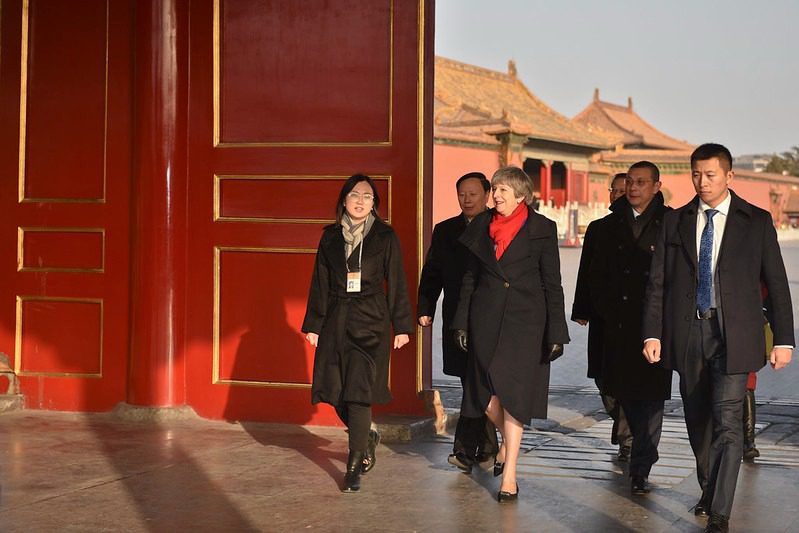
Image: Prime Minister Theresa May visiting China – Number 10
The Beginning of the Deterioration: Hong Kong and Huawei
A decisive shift occurred in 2020. In January, the UK initially allowed Huawei a restricted role in its 5G network, but by July, the government reversed this decision, banning new Huawei equipment and mandating the removal of existing kits by 2027. That same month, following the imposition of the Hong Kong National Security Law, the UK suspended its extradition treaty with Hong Kong and extended its arms embargo to the territory. This marked a clear deterioration in relations, positioning China as a strategic concern rather than a primarily economic partner.
Tensions deepened further in 2021 when the UK opened the British National (Overseas) visa route for eligible Hong Kong residents in January. In March, the UK imposed sanctions on Chinese officials and entities linked to human rights abuses in Xinjiang under its Global Human Rights sanctions regime, a move coordinated with allies as 39 countries signed a joint statement at the UN. China responded by sanctioning UK parliamentarians and institutions, including Iain Duncan Smith and Tom Tugendhat, for criticising their human rights record. Throughout this period, the UK also increased its security signalling in the Indo-Pacific through naval deployments, which met significant opposition from China.
A Long-Term Strategic Challenge
In 2022, the UK hardened its position on Chinese involvement in critical infrastructure, in stark contrast to previous Conservative policy under May and Cameron. The government moved to remove China General Nuclear from the Sizewell C nuclear project, increasing direct UK state involvement instead. This was designed to enable the British economy to benefit directly rather than allowing potentially malicious Chinese corporations access to infrastructure planning.
In October, relations were further strained by a violent incident at the Chinese consulate in Manchester involving Hong Kong protesters, in which several officials and protesters were involved in an altercation after protesters entered the site. Although then-PM Liz Truss expressed “deep concerns,” little was done at the time to fully resolve the diplomatic fallout.
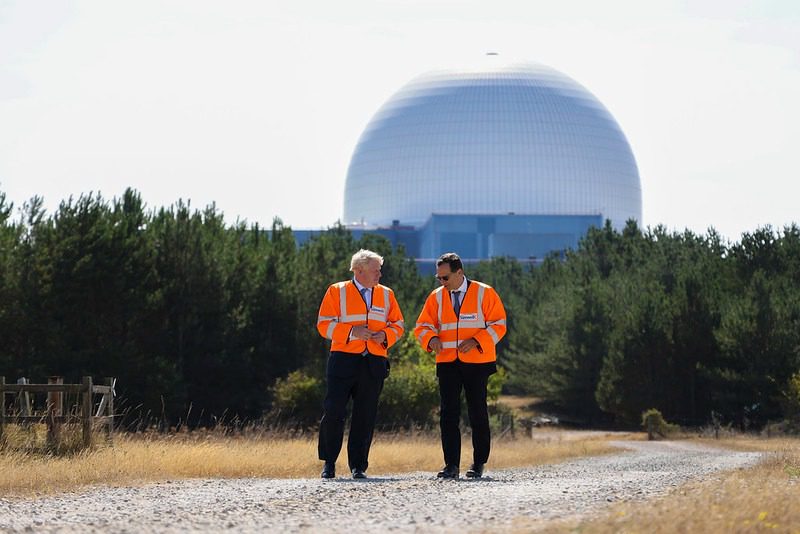
Image: Prime Minister Boris Johnson visits Sizewell C Nuclear Power Station – No 10 / Simon Dawson
By 2023, the UK explicitly defined China as a long-term strategic challenge, particularly concerning cyber espionage. In March, TikTok was banned from government devices on security grounds to prevent the platform’s owners from accessing government data. Later in May, the Integrated Review Refresh described China as an “epoch-defining” challenge to the international order, while maintaining that limited cooperation remained necessary for trade relations. The same year also saw controversy over alleged Chinese “overseas police stations” in the UK, prompting the publication of a major Intelligence and Security Committee report on China. This reinforced that the relationship between the two nations had shifted its focus toward security rather than fiscal cooperation.
Era of Renewal
Following the change of government in 2024, the UK initiated a cross-government “China audit” to reassess its approach, with Prime Minister Keir Starmer attempting to stabilise relations after years of decline. In January 2025, the UK and China restarted the Economic & Financial Dialogue for the first time since 2019, implying that economic cooperation had returned to the forefront of British-Sino negotiations.

Image: Former Foreign Secretary David Lammy – Ben Dance / FCDO
In June 2025, Foreign Secretary David Lammy presented the findings of the China audit to Parliament. He described China as the UK’s most complex bilateral relationship, stressing that while China remains a threat to British security, an economic relationship is crucial to the functioning of the British economy. Despite this re-engagement, security concerns persisted; in December 2025, the Foreign Office and several British companies were subjected to hacking by Chinese-linked actors.
The past decade indicates that relations between the United Kingdom and China have moved through a clear trajectory: from economic cooperation to confrontation driven by security and human rights, followed by a cautious attempt at managed re-engagement. Whether the “super-embassy” will truly benefit Britain is yet to be seen, though this new direction in foreign policy appears to be a calculated step for Britain amidst the current context of shifting global relations.
Featured Image via Department of Business and Trade