


The 20th of January 2026 marks exactly one year since Donald Trump’s second inauguration, as the first-ever convicted felon elected president and only the second president to serve two non-consecutive terms. As has come to be expected of the President and his MAGA administration, this last year in American politics has been volatile, once again returning the United States to the forefront of international relations and global headlines. But what exactly has Trump achieved in his first year, and what could this mean for the future of America?
The Executive Agenda
Trump’s megalomaniacal presidential style for his second term was established hours post-inauguration. This was indicated by his exploitation of executive authority, as Trump chose to sign multiple executive orders, in particular to tackle illegal immigration, attempting to end birthright citizenship and close the border with Mexico. Neither of these attempts was successful, representing a rare triumph for democratic procedure in MAGA America. By choosing to bypass Congress, Trump arguably attempted to transform America into a quasi-authoritarian state not dissimilar to Putin’s Russia, showing absolutely no respect for the will of the people. Unfortunately, although his executive orders largely failed, Trump continued to manipulate, or rather, at least in the latter half of the year, force, the MAGA agenda upon America.
Legislative Victories and Internal Conflict
Power. Money. Corruption. These are the words best associated with the individuals involved in shaping Trump’s second presidency, the most controversial of those being Elon Musk. From a gesture suspiciously similar to a Nazi salute to prejudiced rhetoric on X, Musk fully encapsulated Trump’s vision for America. And yet, their relationship eventually deteriorated over disagreements regarding Trump’s self-proclaimed “One Big Beautiful Bill.”
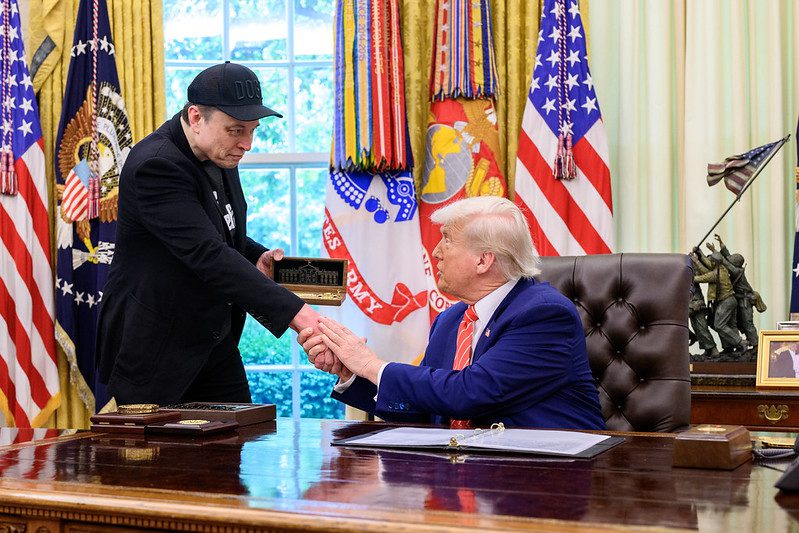
Image: President Donald Trump participates in a press conference with departing DOGE adviser Elon Musk – The White House / Molly Riley
Arguably, Trump’s most significant legislative victory came on the 4th of July with the signing of H.R. 1, enacted as Public Law 119-21 and commonly referred to as the “One Big Beautiful Bill Act,” despite significant public opposition. Although heralded by Trump as a crowning domestic achievement, the act quickly came to symbolise the inherent dichotomies present at the core of his second presidency.
Framed as an exercise in fiscal discipline and national renewal, the legislation instead unsustainably increased federal spending while simultaneously threatening millions of Americans with the loss of healthcare coverage through sweeping Medicaid cuts. This policy very clearly was not for the people of America, but a means to enable Trump to test the constraints of his power.
Foreign Policy and Global Branding
As the year progressed, it became clear that this performative impulse extended far beyond domestic policy. Trump’s approach to foreign affairs throughout 2025 and into early 2026 oscillated between narcissistic bravado and strategic incoherence. In particular, his rhetoric toward NATO allies grew increasingly subversive, as he repeatedly asserted that the United States had funded collective defence for far too long while receiving little in return. Although not entirely inaccurate in its diagnosis, such assertions were catastrophically timed.
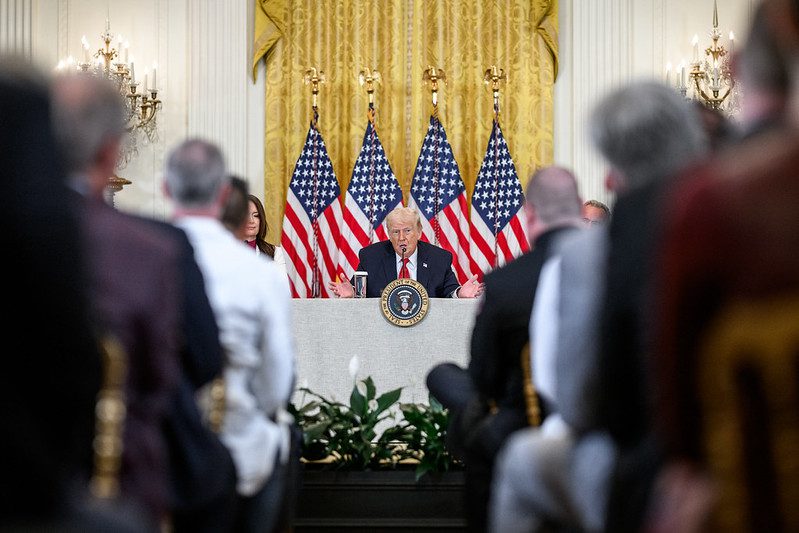
Image: President Trump delivers remarks alongside Secretary of Agriculture Brooke Rollins, HHS Secretary Robert F. Kennedy, Jr., and CMMS Administrator Dr. Mehmet Oz during a Rural Health Transformation Event in the East Room of the White House – The White House / Molly Riley
To threaten foreign aid commitments as war continued to ravage Ukraine was not merely diplomatically reckless, but morally indefensible, especially in the wake of Trump’s fallacious assertions that he alone could end the Russo-Ukrainian conflict. This was exacerbated during the now-infamous Oval Office meeting with President Zelenskyy, in which Trump, alongside Vice President J.D. Vance, publicly demeaned Ukraine’s leader, undermining Western unity and emboldening Russian aggression.
Rather than brokering peace, Trump once again appeared to be more interested in the needs of the powerful and wealthy, in this case, Putin, reinforcing fears that Ukraine had become collateral damage in Trump’s pursuit of a personal legacy. Whether Trump was right to try and forge deeper links with Putin is debatable, considering that a Russo-American alliance could potentially be beneficial for world peace and the global economy, but in the context of the current conflict, Trump cannot be absolved of moral misconduct.
Military Intervention and the “Peace” Project
This same narcissistic egocentrism underpinned Trump’s decision in early 2026 to authorise direct US military action in Venezuela, culminating in the capture of Nicolás Maduro and his removal to the United States. This was an unprecedented escalation that shattered diplomatic norms and reinforced perceptions of American imperial overreach. However, regarding Venezuelan political corruption and the lack of human rights protections, Trump’s intervention was beneficial for the Venezuelan people, although it was not fully altruistic in nature. After all, under the MAGA agenda, profit comes first and individual liberty second.
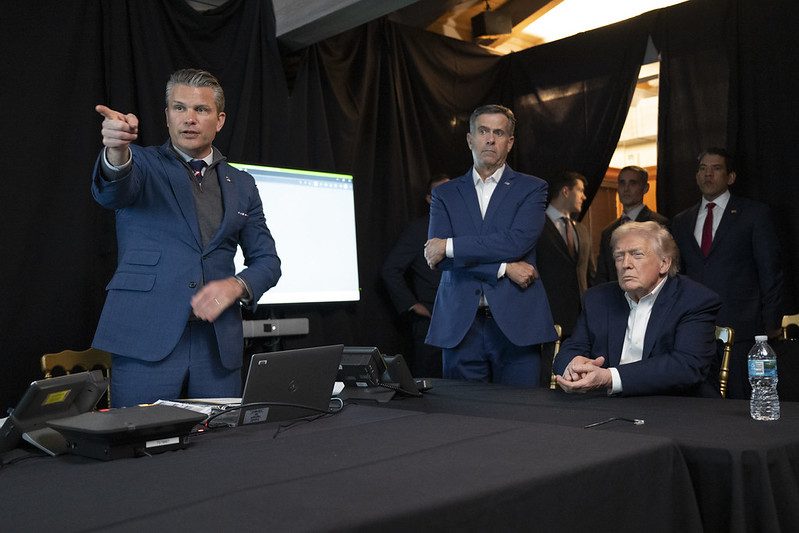
Image: President Donald Trump monitors U.S. military operations in Venezuela, from Mar-a-Lago Club in Palm Beach – The White House / Molly Riley
For example, Trump attempted interventions in South Asia and supposedly brokered peace accords in Central Africa, yet conflict persisted and deals rapidly unravelled, further implying that Trump’s attempts at procuring world peace were purely superficial, an act of grandiose self-glorification. Nowhere was this more evident than in Gaza, where Trump’s proposals for the Israel-Palestine conflict, which remained firmly aligned with Netanyahu, were devoid of any meaningful commitment to Palestinian self-determination. In particular, the now-scrapped suggestion to place Tony Blair in charge of a neutral Gaza administration underscored Trump’s profound detachment from regional realities, considering the hatred for Tony Blair in the Middle East. Peace, once again, was reduced to branding.
Even the awarding of the inaugural FIFA Peace Prize functioned less as a recognition of diplomatic success and more as a grotesque consolidation of Trump’s self-mythologising project. Then again, the FIFA prize was solely created to stroke Trump’s ego, acting as a proxy for the Nobel Peace Prize that Trump failed to win despite his consistent claims it should be awarded to him.
Domestic Tension and the Epstein Scandal
Domestically, the same coercive logic prevailed. Immigration enforcement intensified relentlessly, with ICE empowered to expand raids, detentions, and deportations throughout the year. This campaign reached a new level of controversy following the fatal shooting of a civilian during an ICE operation, an incident that crystallised fears that enforcement under Trump had become not merely punitive, but dangerously unaccountable.
Rather than recalibrate, Trump framed criticism as betrayal, doubling down on enforcement as proof of strength while portraying the victim as an enemy to American security and a traitor to her nation. In regard to immigration policy, Trump’s rhetoric and policy alike have not been dissimilar to previous totalitarian regimes across the globe and throughout history, posing the question of whether Trump has become the greatest threat to Western liberal democracy.
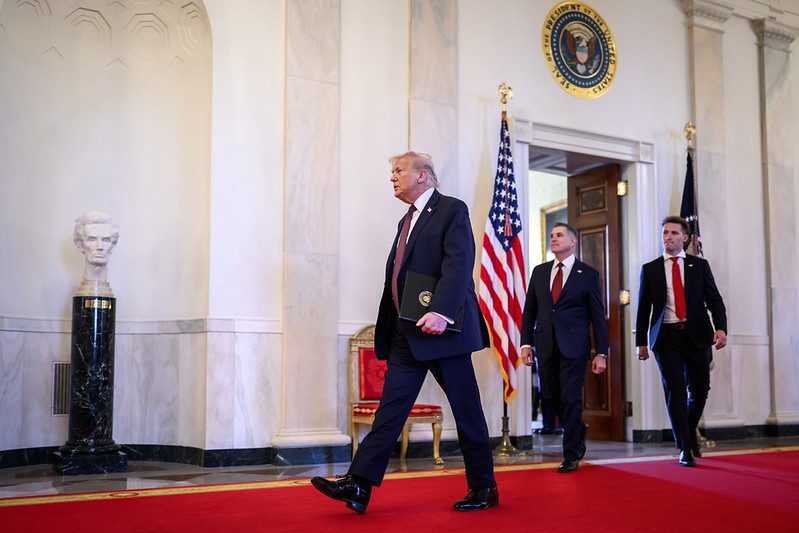
Image: President Donald Trump enters the East Room for an event honouring the 2025 Stanley Cup champion Florida Panthers – The White House / Molly Riley
Outside of domestic policy, the resurfacing of the Jeffrey Epstein scandal became one of the most politically corrosive episodes of Trump’s first year back in office. Demands for the release of Epstein-related files intensified throughout late 2025, placing the administration under sustained pressure, not from Democrats, but from within Trump’s own ideological base. This peaked when Marjorie Taylor Greene publicly accused the administration of deliberate obstruction before announcing her resignation from Congress effective January 2026.
Repeated failures by the Department of Justice to meet statutory disclosure deadlines, followed by inconsistent explanations regarding the handling of newly uncovered material, only deepened public distrust, especially considering how released files seemed to feature a substantial collection of images of Trump. Perhaps breaking promises here was beneficial for America, for the scandal exposed fractures within the MAGA coalition itself, revealing the limits of Trump’s authority over a movement increasingly willing to turn inward when denied accountability. The MAGA agenda may not be immortal and indestructible.
Conclusion
One year on from Trump’s second inauguration, America has certainly been transformed by Trump, but certainly not for the better. He has not delivered stability, peace, or democracy; instead, he has normalised chaos as a governing strategy for self-aggrandisement, thus entrenching division both at home and abroad. As America enters the second year of Trump’s second presidency, it does so more polarised, more isolated, and more precarious than it was twelve months earlier. The question is no longer what Trump has achieved, but how much damage remains to be done.
Featured Image via The White House / Andrea Hanks