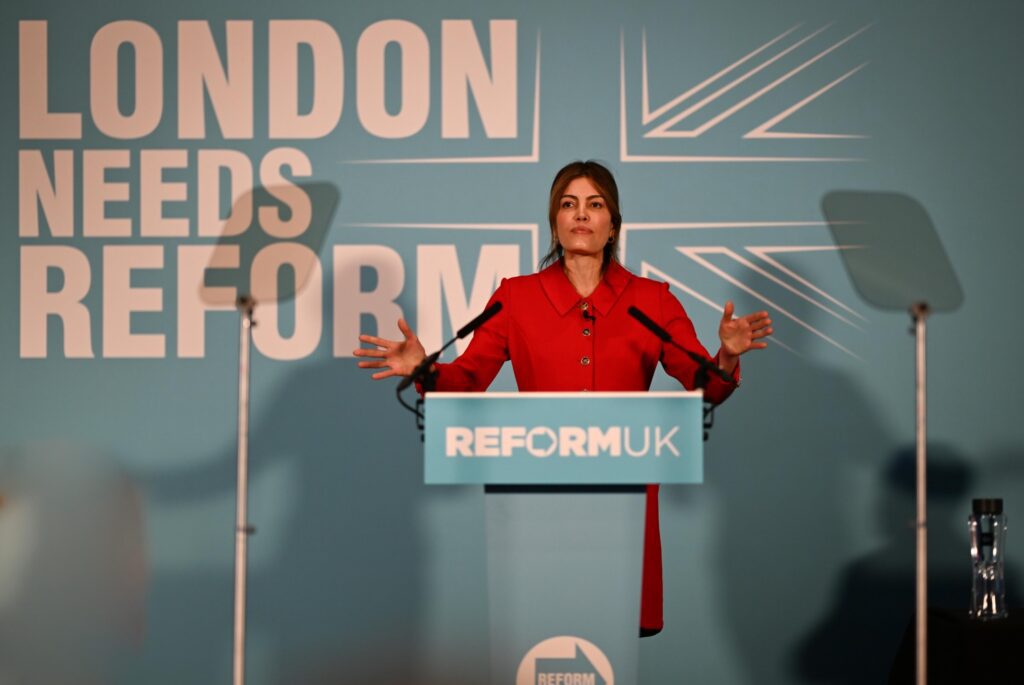

Following her announcement as Reform UK’s London Mayoral Candidate for 2028, Laila Cunningham has become an increasingly visible presence in Britain’s political conversation. But who exactly is she?
Originally elected in May 2022 as a Conservative councillor for Lancaster Gate on Westminster City Council, Cunningham’s time in elected office has so far been brief but eventful. Her defection to Reform UK in 2025 made her the party’s first sitting councillor in a London borough, a move that attracted attention both for its symbolism and for what it implied regarding the Conservatives’ continuing difficulty retaining those further right within the party.
Cunningham’s background, however, is divergent from the typical profile of populist politicians. Born in Paddington, she trained as a lawyer and spent much of her professional life working as a senior prosecutor for the Crown Prosecution Service, not dissimilar from Keir Starmer. Prior to her entry into local government, she built a career largely outside of electoral politics, combining legal work with entrepreneurial projects and advocacy around women’s issues, enabling her to utilise that experience to provide evidence of her credentials on crime and public safety.
Her political alignment with the Conservatives proved to be increasingly uneasy. Whilst still a Tory, Cunningham became openly critical of the party’s record on law and order, immigration, and taxation, arguing that it had drifted too far from the concerns of ordinary voters, thus preluding her inevitable defection to Reform.
Interestingly, Cunningham is a practicing Muslim, yet has consistently been critical about British policy regarding immigrants from Muslim-dominated countries, stating in a post on X that the government should “ban visas to Pakistan until abusers are taken back”. This comment was in response to Sadiq Khan’s denial that grooming gangs currently operate at the levels Reform UK has suggested, further demonstrating Cunningham’s commitment to appearing as the candidate to protect women and girls.
Earlier last year, at the Reform Conference, Cunningham spoke at the women for Reform panel, citing there that she had left the Conservative party as a result of their inability to hold perpetrators of child sexual exploitation accountable.
Since joining Reform UK, Cunningham has positioned herself as one of the party’s most outspoken voices on crime, frequently attacking London’s political establishment and Mayor Sadiq Khan in particular. Her rhetoric, which depicts the capital as increasingly unsafe and poorly governed, has been welcomed by Reform supporters but criticised by opponents as simply populist fearmongering, a sentiment that has been consistently levelled at Reform for their hard-right stances.
Ultimately, Laila Cunningham is best understood as part of Reform UK’s broader attempt to cultivate figures with institutional credibility as well as insurgent appeal. Her move from prosecutor to councillor to Reform standard-bearer reflects both the party’s strategic ambitions in London and the continuing fragmentation of the Conservative right, therefore implying that Reform has essentially replaced the Conservative party as the party of justice and national security.
Whether her rise marks the beginning of a durable political career or merely another episode in Reform’s ongoing experiment with high-profile defectors remains to be seen. For a party keen to shed the image of a protest vehicle for disaffected Conservatives, Cunningham represents both an opportunity, and a test. Whether Reform will benefit from placing another Tory defect in the political spotlight again is questionable, but is a risk that Farage is clearly willing to take.
Featured image: Reform UK