


As the world prepares to welcome the new year, Myanmar confronts a major political test on the eve of 2026. The country will officially begin its first staggered general election in five years. To the ruling military junta, the State Administration Council (SAC), this date is framed as a “reset”, a return to the “multiparty democratic path” they claim was subverted in 2020. However, for the millions of citizens living under the shadow of a brutal and intensifying civil war, this is no democratic exercise. It is a desperate, bloody attempt by a failing regime to institutionalise its power while the country crumbles.
A Staggered Farce: Geography of a Sham
The December 28th vote is merely the first of three phases, with subsequent rounds planned for January 11 and 25, 2026. However, the physical reality of the vote reveals its illegitimacy. According to the junta’s own Union Election Commission (UEC), voting is cancelled in at least 56 out of 330 townships and over 121 constituencies.
Independent analysts, including the BBC and Council on Foreign Relations, estimate the military holds firm control over only 21% to 25% of the country. In the “liberated zone” of Sagaing, Magway, and other ethnic states including the Shan state voting has been banned. By excluding these regions, the military is not just holding a flawed election; it is effectively disenfranchising half the nation to ensure a victory for its proxy, the Union Solidarity and Development Party (USDP).
The Human Cost: A Legacy of Five Years of Blood
While the junta prepares polling stations, the people of Myanmar endure a humanitarian catastrophe. The “suffering” described by international monitors is not abstract; it is a daily fight for survival against a regime that has turned the tools of the state against its own people.
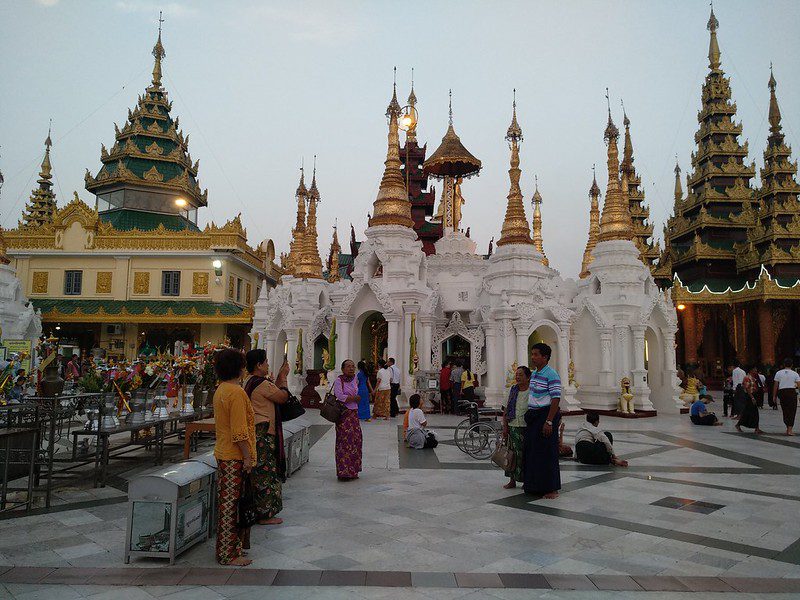
Image: Life in Myanmar at the Shwedagon pagoda in Yangon before the chaos of the coup – Stella Paul / IPS
Over 3.5 million people are now internally displaced. Following a catastrophic 7.7 magnitude earthquake in March 2025 and devastating floods earlier in the year, the misery has compounded. The World Food Programme (WFP) warns that 16 million people, nearly one-third of the population, now face acute food insecurity.
In a desperate bid to cement control before the polls, the military has intensified its “campaign of terror.” Airstrikes and drone attacks increased by 30% in 2025 alone. Just weeks ago, on December 11, a junta airstrike hit a hospital in Mrauk-U, killing dozens of patients and medical staff. This followed an attack on a tea shop in Tabayin that killed eighteen civilians watching a football match.
Facing dwindling ranks and mass desertations (estimated at 20,000 soldiers since the coup), the junta has turned to “conscription-related abductions.” Young people are being snatched from the streets of Yangon and Mandalay as human shields or front-line fodder, leading to a massive exodus of the country’s youth to Thailand.
Engineering a “Result”
The legal framework of this election is a masterclass in authoritarian engineering. The junta has replaced the “First Past the Post” system with Proportional Representation (PR), combined with a 25% seat reservation for the military. This ensures that even with a fraction of the popular vote, the military can maintain a “legal” grip on the legislature.
Furthermore, the National League for Democracy (NLD), the party that won a landslide in 2020, has been dissolved. Its leaders, including Nobel Laureate Aung San Suu Kyi, remain in solitary confinement. A new Election Protection Law enacted in July has seen over 267 people charged for “interfering” with the poll, a charge that can be triggered by merely liking a social media post critical of the process. In some cases, young activists have been sentenced to 49 years in prison for hanging anti-election posters.`
A Cry for Recognition
The junta’s true target audience for this election is not the people of Myanmar, who have responded with “silent strikes” and boycotts, but foreign governments. While Western nations and the UN have unequivocally denounced the “charade,” regional powers like China, India and Russia have offered varying degrees of support, viewing the vote as a potential “off-ramp” for regional instability.
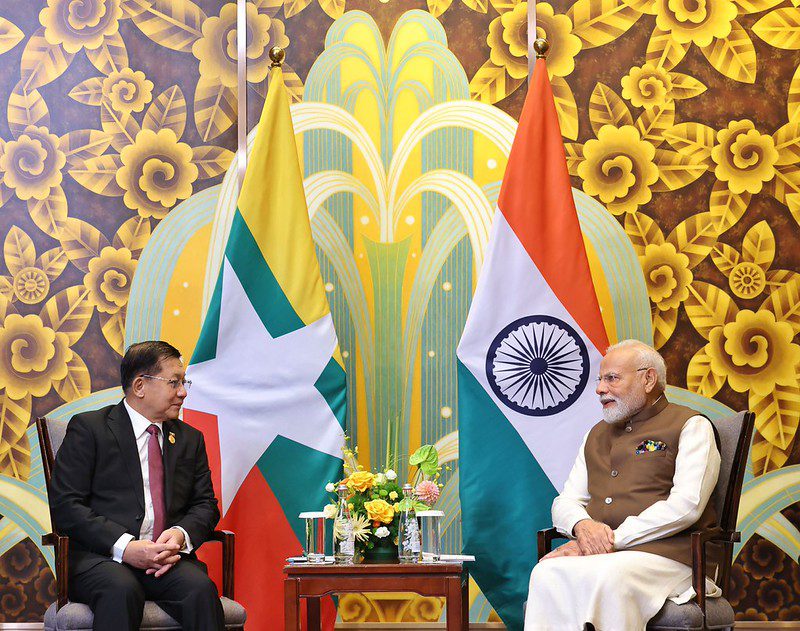
Image: Prime Minister Narendra Modi met Senior General Min Aung Hlaing on the sidelines of the SCO Summit in Tianjin, China – MEAPhotoGallery
For the citizen standing in a polling line in Mandalay today, the “reality” is not a choice of policy. It is a choice between participating in a stage-managed performance or facing the lethal consequences of dissent. Outside the urban bubbles, the reality remains the smell of smoke and the sound of jet engines.
The wars in Ukraine and Gaza continue to hold the world’s attention, whilst the suffering in Myanmar goes largely under the radar. The December 28th election will not bring peace; it is merely a new, more clinical chapter in the military’s long-running war against the sole of Myanmar.
Featured Image via Leo Bild via Flickr