
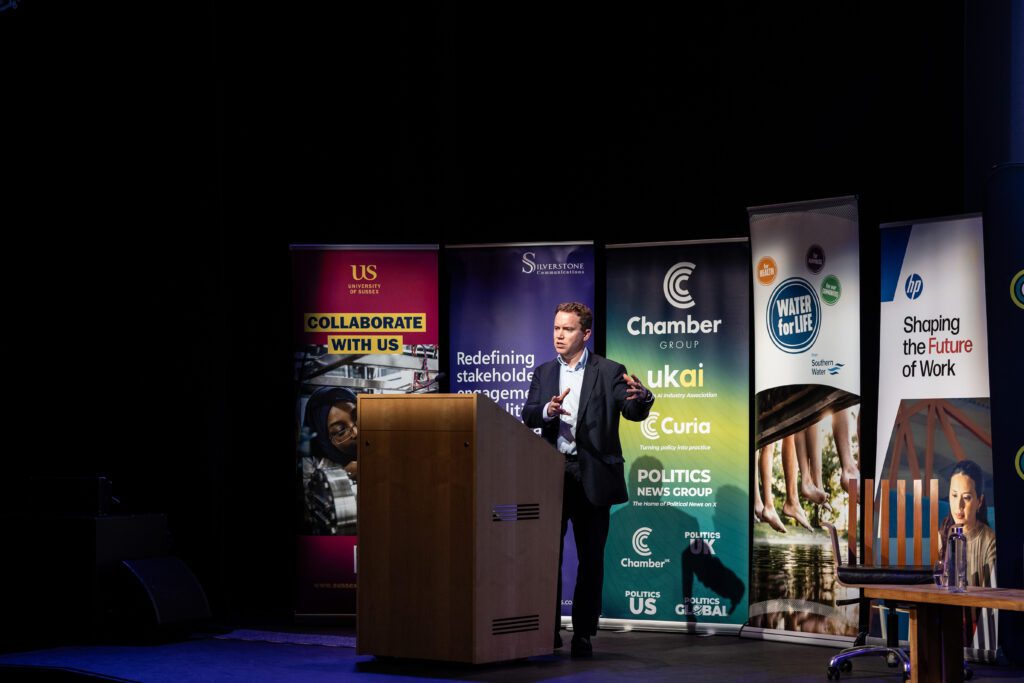
As leaders from across the South East gathered in Brighton to discuss ways to increase economic growth in the region, a key question arose: should artificial intelligence be a tool for growth?
Advertorial: This event and writeup was sponsored by HP. Chamber UK retained editorial control of the agenda and outputs from the event.
(Image: Neil Sawyer, Senior Vice President and Managing Director, Northern Europe, at HP addresses the Get Britain Growing South East Conference. Photo: Silverstone Communications)
Artificial intelligence (AI) can be a tool for “growth, not disruption”, said Neil Sawyer, Senior Vice President and Managing Director, Northern Europe, at HP. His keynote speech formed part of the programme for the Get Britain Growing: South East Conference, an event that facilitated discussions on the region’s future economic growth.
Held in collaboration with Chamber UK, Curia and UKAI, the conference focused on how the South East can stay globally competitive while tackling local challenges – from infrastructure pressures and water resilience to housing, skills gaps and attracting sustainable investment.
AI at a “tipping point”
Sawyer addressed one of the main arguments often advanced by AI sceptics – the importance of human interaction – alongside fears about job losses and technology takeovers. He sought to assuage such concerns by encouraging local collaboration and highlighting the value of education and lifelong learning for communities in Sussex and across the South East: “Nothing replaces human interaction; it builds trust, authenticity, and innovation. That’s how we’ll make AI a tool for growth, not disruption.”
He expanded on how AI presents a significant opportunity for education and the future of work, especially for neurodiverse children and those who do not conform to formal learning. The use of agentic aids and teaching assistants, he explained, can enhance students’ education with materials finely “curated to the way in which they learn”.
He added that he “firmly” believes “that the UK is at the tipping point of being able to lead the world in terms of not just the development of AI, but how it’s used in the many different practices, both in local society, but also across enterprise”.
UK leadership in cybersecurity and HP’s investment
He described the Government’s investments in AI infrastructure as “seismic”, highlighting his particular interest in “how energy creation can keep up with the demands that exist with AI”.
The rapid construction and cooling of data centres will require substantial energy and a more robust sustainability framework as the technology continues to develop. Above all, “security” is key, “remaining at the heartbeat of everything that we do”. Sawyer celebrated the UK’s status as “a specialist in global cybersecurity”, arguing that investment in people, science and technology can foster world leadership.
Sawyer said he is “very proud” of HP’s rich technological history and its legacy of research and innovation: “HP was the founder of Silicon Valley in 1939. He described HP as a “community” – and the “longest-standing and oldest technology” community at that.
The South East and HP in partnership
“Why are HP here today in Sussex?” Sawyer asked. Collectively, the region is “a valuable customer” to HP – the company “touches 50 per cent of homes” through technology used every single day.
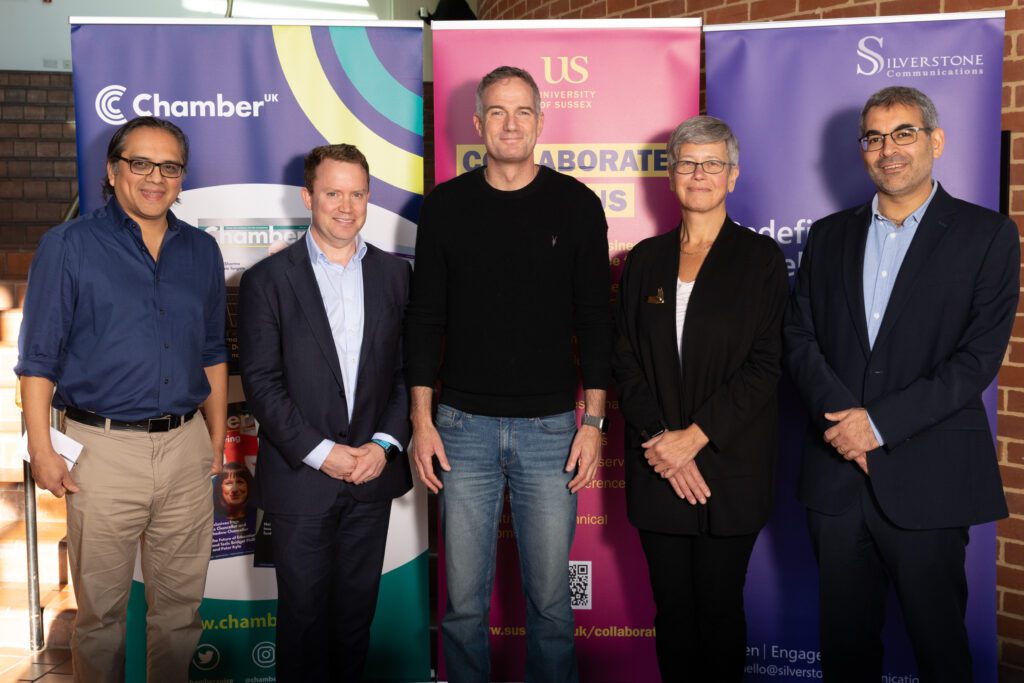
HP, he emphasised, aims to promote dialogue and “authentic discussion” around skills and training for young people and those in established or mid-careers, helping to “solve and understand employers’ problems”.
HP’s AI strategy: edge computing
Sawyer outlined the shift from search engines to answer engines such as ChatGPT, insisting that “there isn’t enough power in this world to cope with the number of queries and answers people are looking for”.
HP’s strategy, he explained, involves moving AI processing to devices – edge computing – developed with partners including Nvidia, Google, Microsoft, AMD, Intel, and Qualcomm.
This shift will be transformational, he argued: “Much of what is asked in a data centre over the next 12 months and beyond will be answered on these devices.”
Not only will this be “more environmentally efficient”, but it will also increase security and reduce latency. This device-centric approach will benefit education and healthcare, enabling quicker answers to patient questions and disease diagnosis.
Final thought
Sawyer highlighted HP’s ambition to reduce the environmental footprint of data centres while improving access to real-time learning and problem-solving tools across schools, hospitals, and businesses.
As with many discussions at the Get Britain Growing: South East Conference, his speech emphasised how digital infrastructure, cybersecurity and skills development will underpin the UK’s AI future. He stressed that the UK remains a global leader in cybersecurity research and advocated continued investment in people and technology – factors that will be crucial to the country’s success in the era of AI.
www.hp.com